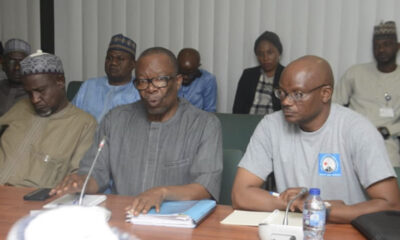
The Academic Staff Union of Universities (ASUU) has officially declared a two-week comprehensive warning strike, marking yet another disruption in Nigeria’s public university system.
The announcement was made on Sunday by the National President of the union, Professor Chris Piwuna, during a press briefing held at the University of Abuja.
According to the ASUU president, the decision followed the expiration of a 14-day ultimatum earlier issued to the Federal Government on September 28, 2025. He stated that the strike would commence at midnight on Monday, October 13, 2025, and would involve the total withdrawal of services from all public universities across the country.
Read Also:
Experts, Scholars Chart Path for Zero-Waste Leather Production at NILEST Conference
“Compatriots of the press, it goes without saying that there is nothing sufficient on ground to stop the implementation of the ASUU-NEC’s resolution to embark on a two-week warning strike at the expiry of the 14-day notice given on the 28th September 2025,” Professor Piwuna declared. “Consequently, all branches of ASUU are hereby directed to withdraw their services with effect from midnight on Monday, the 13th October, 2025. The warning strike shall be total and comprehensive as agreed at the last NEC meeting.”
ASUU, formed in 1978 to represent the interests and welfare of university lecturers in Nigeria, has been in constant dispute with the Federal Government over issues of funding, welfare, and the implementation of agreements reached as far back as 2009.
Education analysts have expressed concerns that the fresh industrial action could further derail the already fragile academic calendar, especially for students who are yet to recover from previous disruptions. Some institutions had only recently resumed following delays linked to unpaid salaries and infrastructural challenges.
The latest standoff comes despite ongoing negotiations between the Federal Government and the university-based unions. On Wednesday, the Minister of Education, Dr. Tunji Alausa, revealed that the administration was in the final phase of talks with ASUU and other unions to resolve outstanding issues relating to university funding and staff welfare.
Dr. Alausa explained that the government had made significant progress by releasing ₦50 billion for Earned Academic Allowances (EAA) and earmarking another ₦150 billion in the 2025 budget for needs assessment in public universities. He said the funds would be released in three tranches as part of efforts to address ASUU’s demands and stabilize the education sector.
However, the union insists that the government’s actions have not matched its promises. Many lecturers have argued that the delay in implementing key aspects of the 2009 ASUU-FGN Agreement and the continued use of the Integrated Payroll and Personnel Information System (IPPIS) have worsened their plight.
Students across various campuses have expressed worry over the renewed strike, describing it as a major setback to their academic progress. A 400-level student of the University of Lagos, identified as Tolu, said, “We are tired of this constant back and forth. Every time there’s progress, another strike begins, and it affects our graduation timelines.”
Education rights advocates have urged the Federal Government to prioritize university reforms and ensure that the recurrent cycle of strikes comes to an end. According to them, the government must strengthen communication with stakeholders to rebuild trust in Nigeria’s higher education system.
Observers note that the strike could worsen the ongoing brain drain in the sector, as more lecturers may seek opportunities abroad due to poor working conditions. Nigeria has already recorded the exit of over 300 professors from public universities in the last two years.
Advert
University managements across the country have started issuing circulars directing students to vacate campuses pending further instructions. The National Universities Commission (NUC) is expected to meet with stakeholders this week to assess the situation and explore possible resolutions.
Meanwhile, the ASUU leadership maintains that the warning strike is not an end in itself but a call for government accountability and action. Professor Piwuna emphasized that the union would review its position after the two-week period, depending on the government’s response.
“We have waited long enough, and our members have endured enough hardship. This warning strike is to show our seriousness in demanding that the government fulfill its obligations,” he added.
Education experts have cautioned that unless urgent steps are taken, the strike could extend beyond two weeks, causing further instability in Nigeria’s struggling tertiary education sector.