By Grace Misimadji Simeon
For years, residents of Maiduguri have been accustomed to the city’s intense heat. But increasingly unpredictable weather patterns are making life in the Borno State capital more difficult, with extreme heat, irregular rainfall, flooding and prolonged dry conditions becoming major concerns.
Climate change is no longer a distant environmental issue for Maiduguri. It is increasingly visible in the daily lives of residents, affecting homes, businesses, transportation, agriculture, health, and access to water.
A City Caught Between Heat and Floods
Maiduguri sits within the semi-arid Sahel region, where temperatures can become extremely high and rainfall is naturally limited. However, climate variability is making weather patterns less predictable.
A 2024 study examining climate patterns across northeastern Nigeria found changing rainfall trends in Maiduguri and several other locations in the region. Researchers say understanding these changes is important because variations in temperature and rainfall can affect agriculture, water resources, and human activities.
The problem is not simply that Maiduguri receives too much or too little rain. The timing and intensity of rainfall matter.
Research published in 2025 on the Maiduguri catchment found that rainfall declined significantly between 2012 and 2018 after higher rainfall levels between 1999 and 2011. The study also recorded flooding events in 16 of the 20 years examined.
This creates a difficult contradiction: residents can experience long periods of dryness and water stress, followed by intense rainfall capable of overwhelming drainage systems.
The Flood That Changed the Conversation
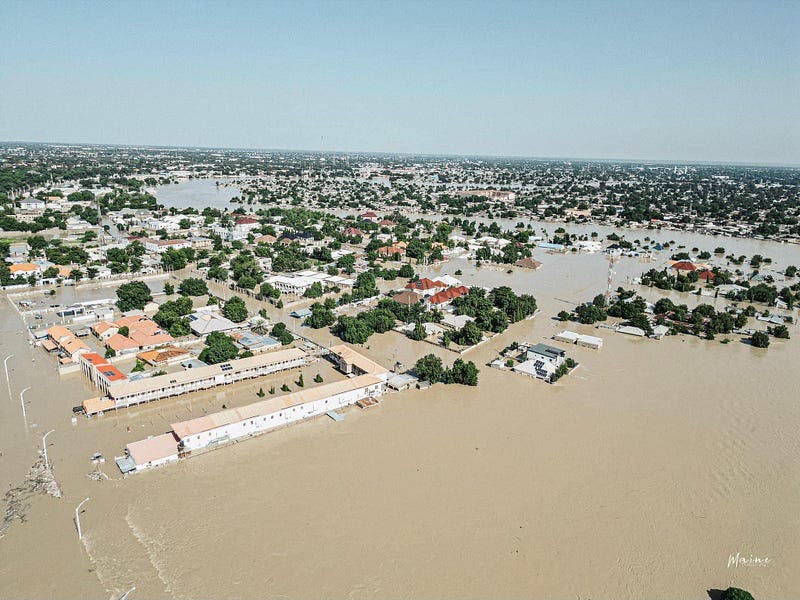
The danger became painfully clear in September 2024, when devastating floods hit Maiduguri following torrential rainfall and the failure of the Alau Dam.
Homes, businesses, roads, and public infrastructure were submerged, forcing large numbers of residents from their communities. The disaster was among the most severe floods the city had experienced in decades.
A 2025 study of the disaster found an upward trend in seasonal rainfall between 1992 and 2024, while its analysis of the 2024 event identified an unusually high rainfall anomaly. The study estimated that more than 157,000 people were displaced by the flood and identified inadequate infrastructure maintenance and weak early-warning systems as factors that worsened its effects.
For residents who lost homes and businesses, climate change was not a scientific concept discussed only in classrooms. It became a question of survival.
Some Maiduguri residents lost their businesses and possessions during the flood, while communities worked together to recover and rebuild after the disaster.
Heat Is Another Threat
While flooding attracts attention because of its sudden destruction, extreme heat is a slower and less visible danger.
Maiduguri’s hot climate already places pressure on residents, particularly people who work outdoors. Farmers, traders, construction workers, commercial transport operators, and other outdoor workers can spend several hours exposed to intense heat.
Recent reports have described Maiduguri and Borno as particularly vulnerable to climate change because of rising temperatures, changing rainfall patterns, and extreme weather. Health professionals have also been working to help communities adapt to extreme heat.
For students, the heat can also affect concentration and comfort in classrooms and lecture halls, particularly where ventilation, electricity, or cooling systems are inadequate.
The Pressure on Water and Agriculture
Climate change also threatens the resources on which Maiduguri and surrounding communities depend.
When rainfall becomes unreliable, farmers face difficulties determining when to plant and how long crops will receive sufficient water. Prolonged dry periods can increase pressure on available water resources, while intense rainfall can wash away crops and damage farmland.
The consequences can eventually reach urban residents through food prices.
Maiduguri’s connection to the wider Lake Chad Basin makes water management particularly important. Researchers studying the region have identified significant changes in rainfall and streamflow patterns, raising concerns about long-term water-resource management.
Flooding and Public Health
Climate-related flooding is not only an environmental problem; it is also a public-health concern.
Floodwater can contaminate sources of drinking water and create conditions favourable to waterborne diseases. Communities and displaced-persons camps around Maiduguri located in flood-prone areas can therefore face increased risks of displacement and disease.
This makes climate adaptation particularly important for vulnerable populations, including children, older people, displaced families, and low-income households.
What Can Maiduguri Do?
Climate change cannot be solved by Maiduguri alone, but the city can become more resilient.
One important step is urban planning. Construction should be controlled in flood-prone areas, and natural waterways should be protected.
Drainage systems also need regular maintenance and expansion where necessary. The 2024 flood demonstrated how quickly water can overwhelm vulnerable infrastructure.
Tree planting should become a sustained citywide programme rather than an occasional campaign. Trees provide shade, help reduce heat, and can contribute to environmental restoration.
Waste management is equally important. Residents should stop dumping refuse into drainage channels, while authorities need to provide reliable waste collection and enforce environmental regulations.
Maiduguri also needs stronger early-warning systems. Residents should receive timely information about heavy rainfall, flooding, and extreme heat through radio, television, mobile phones, and social media.
Finally, climate education should become part of community life. Schools, universities, religious institutions, community organisations, and the media can help residents understand how everyday actions such as tree cutting, waste disposal, and excessive use of fossil fuels contribute to environmental problems.
A Responsibility Shared by Everyone
The climate challenge facing Maiduguri is bigger than one government agency or one community. Government must provide resilient infrastructure and effective environmental policies, but residents also have a role to play.
A city that plants trees, protects waterways, maintains drainage systems, manages waste properly, and prepares communities for extreme weather will be better positioned to withstand future climate shocks.
Maiduguri has already experienced what extreme weather can do. The question now is whether the city will wait for another disaster or use the lessons of the past to prepare for what lies ahead.
Climate change may be global, but its consequences are local. In Maiduguri, they are being felt in the heat, seen in the floods, and experienced in the daily struggles of residents.
The response, therefore, must begin where the impact is being felt — in the communities, streets, schools, markets, and homes of Maiduguri.