By Abubakar M. Kareto
Cities across the world survive and thrive on their ability to move people, goods, and ideas without friction.
For decades, the famous Post Office hub in Maiduguri stood as both the commercial heartbeat of Borno State and its most agonizing physical bottleneck.
Anyone who crossed that intersection during evening rush hour remembers the suffocating reality: hundreds of Keke NAPEP tricycles locked wheel-to-wheel, civil servants stranded under the fading heat, exhaust fumes hanging thick in the air, and a simple five-minute commute stretching into an exhausting forty-five-minute ordeal. It was an invisible tax on human patience, local productivity, and civic sanity.
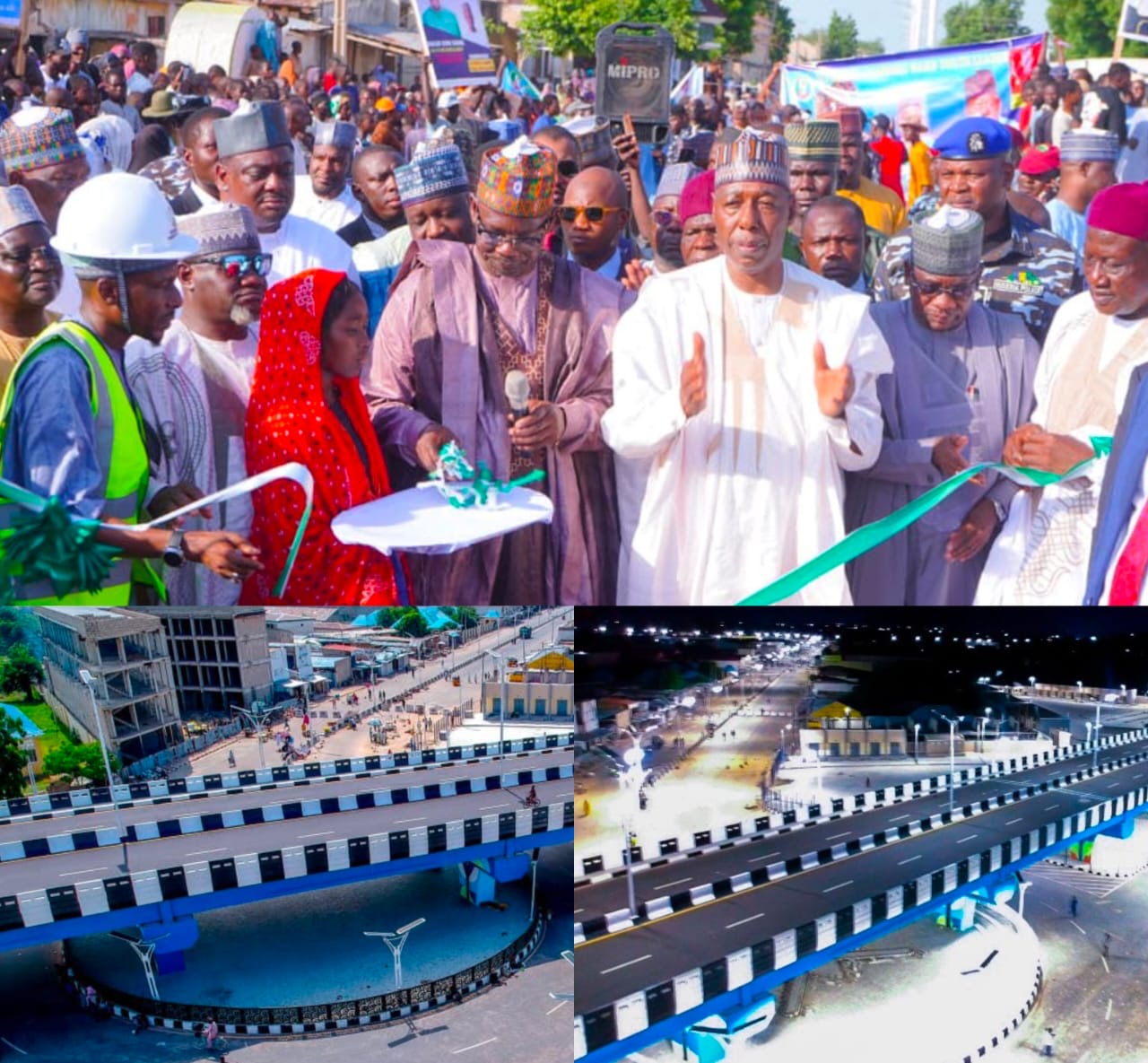
The formal commissioning of the Post Office nine-span flyover, paired with the dualized express road linking Budum Tandari Junction through Kasuwan Shanu to the NIETAL shoe factory, has decisively broken that chokehold. What used to be a nerve-racking daily struggle is now a smooth, three-minute glide above the city center.
By separating fast through-traffic on an elevated deck from the local commerce below, the new structure restores order, speed, and safety to the capital’s busiest crossroad. Delivery vans move freely, market stalls breathe again, and the historic downtown finally enjoys the efficiency of a modern metropolis.
This intervention carries weight far beyond municipal convenience. Maiduguri is not an ordinary inland capital; it is the historic gateway to the entire Lake Chad Basin, linking vital trade routes that connect Nigeria with Chad, Cameroon, and Niger.
By modernizing the central Post Office spine and dualizing the corridor through Kasuwan Shanu, Borno has effectively unclogged a critical artery of trans-Sahelian commerce. Crucially, the project pairs fresh dual carriage lanes with five kilometers of deep, integrated drainage channels.
In a semi-arid zone prone to seasonal flash flooding, building roads without massive water runoff management is money thrown to the wind. This foresight guarantees that a multi-billion-naira regional trade artery will last for generations rather than wash away after the next rainy season.
The sheer scale of what has unfolded in Maiduguri caught even seasoned observers off guard. When Nasarawa State Governor Engr. Abdullahi Sule stood before the microphone as special guest of honour, he visibly set aside his prepared text to speak straight from the heart. Governor Sule, himself an engineer and seasoned industrial executive, admitted that no speechwriter could capture what he witnessed on ground, noting that what he saw in Borno deserved two hours of unscripted praise.
When a fellow engineer and state executive drops official diplomacy to marvel openly at the quality of execution, it confirms that this is not standard political posturing, but a genuine technical triumph.
Delivering complex civil engineering works under strict timelines requires exceptional professional integrity from the institutions behind the scenes. The Borno State Ministry of Works and Housing has demonstrated an inspiring model of continuity and competence.
Conceived and initiated in early 2023, the foundational structural blueprints, rigorous procurement vetting, and initial site operations were solidly anchored under the immediate past Commissioner of Works, Engr. Mustapha Gubio. His uncompromising commitment to engineering best practices ensured that every bridge pier and sub-base began on solid ground.
Taking over such a high-velocity portfolio without slowing down requires sharp technical agility, and the current Commissioner of Works, Engr. Adam Bababe, met the challenge head-on. Engr. Bababe sustained the project momentum, kept contractors strictly accountable to international safety and structural benchmarks, and drove the flyover to completion with exceptional hands-on leadership.
The smooth transition between these two engineering leaders provides a rare, commendable lesson in how public institutions ought to function when collective progress comes before personal ego.
A few years ago, hardly anyone believed that a state confronting the brutal challenges of prolonged insecurity could simultaneously compete with the most resource-endowed states in the Federation in urban renewal and infrastructural modernization. Conventional logic suggested that survival would exhaust every ounce of public energy.
Yet, Professor Babagana Umara Zulum has utterly rewritten that script, proving the skeptics wrong and rekindling genuine hope for the future. What we see unfolding on the streets of Maiduguri is not an accidental miracle; it is the deliberate, repeatable dividend of visionary leadership and disciplined governance.
By delivering its fourth major flyover alongside an expanding web of modern dual carriageways, the Zulum administration sends a resounding message to the nation and the international community. Concrete, steel, and open corridors of commerce are the unmistakable language of permanent stability and investor confidence.
Maiduguri is stepping out of the shadows of the past, standing tall, and reclaiming its rightful place as the proud economic powerhouse of the region.
Abubakar M. Kareto is a Public Affairs Analyst, Commentator, and Communications Strategist. His focus includes governance, policy, politics, economy, and media dynamics in Nigeria and Africa. He can be reached via email at amkareto@gmail.com and on X (formerly Twitter) @amkareto.