By Abubakar M. Kareto
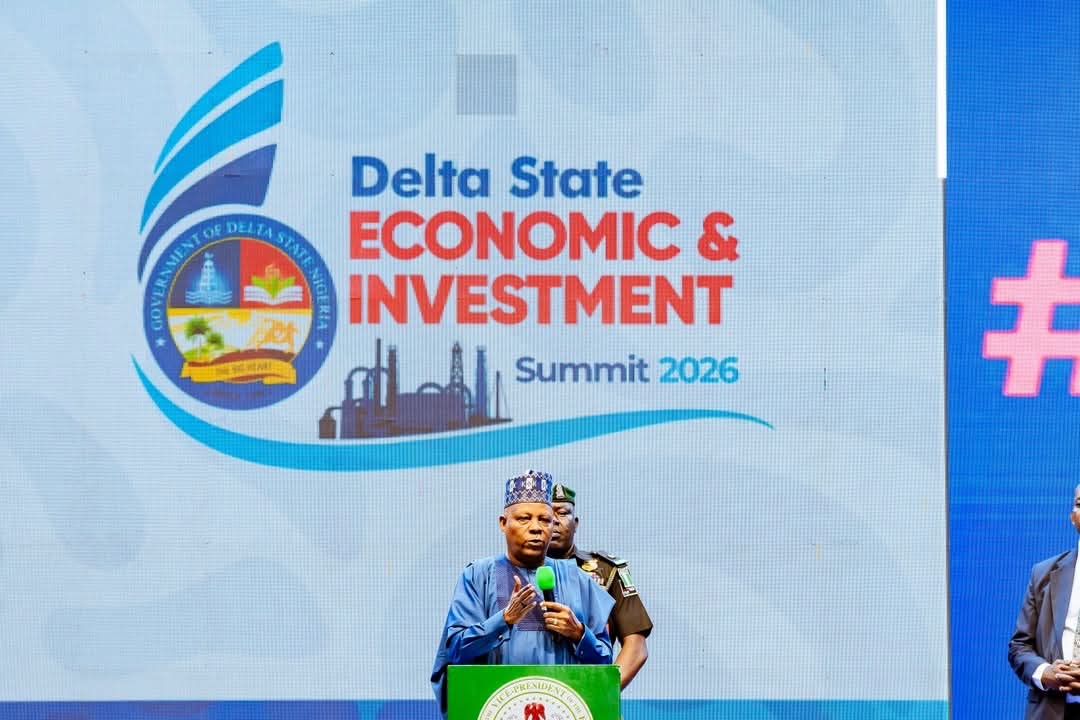
The keynote address delivered by Vice President Kashim Shettima at the Delta State Economic and Investment Summit 2026 marks a decisive turning point in Nigeria’s subnational political economy. By framing state level interaction through the lens of productive rivalry, Vice President Shettima articulated a vision where subnational entities serve as the primary drivers of national growth. His presentation moved well past routine political rhetoric, offering an analytical blueprint for how states must adapt to an evolving fiscal reality.
For decades, Nigeria’s developmental narrative was dictated almost entirely by centralized federal initiatives. Vice President Shettima’s emphasis on a healthy cycle of competition reflects a deeper economic principle: when individual states actively compete for private capital, infrastructure projects, and top tier talent, the productive capacity of the entire nation expands. This competitive federalism demands that states abandon generic planning in favor of strategies tailored to their unique geographical advantages, historical strengths, and resource endowments.
A crucial highlight of Vice President Shettima’s address was the urgency of transitioning from asset mapping to practical execution. Many state governments historically compiled inventories of unexploited natural resources without establishing the regulatory frameworks or physical infrastructure required to attract serious institutional investors. Capital allocation alone does not create wealth. Modern subnational administration requires removing bureaucratic bottlenecks, enforcing contract sanctity, and building reliable infrastructure so that investment summits yield actual industrial operations rather than unfulfilled memorandum of understanding documents.
For resource-rich territories like Delta State, which ranks among the top subnational economies in the country with an estimated gross domestic product exceeding 6.3 trillion Naira, Vice President Shettima’s call for economic diversification carries urgent relevance. Relying on a single volatile commodity leaves state budgets vulnerable to global market shocks and the global energy transition. Natural resource revenues can fund foundational infrastructure, but only robust institutions, predictable economic policy, and private enterprise can sustain prosperity over generations. Moving capital into high value sectors like manufacturing, technology, and services represents the ultimate measure of forward-looking leadership.
This imperative for subnationals to independently engineer their economic engines is confirmed by global developmental precedents. In China, subnational economic experimentation allowed coastal provinces like Guangdong to generate over 1.9 trillion Dollars in gross domestic product, operating effectively as an economic power comparable to entire sovereign nations. Similarly, in federal systems like Germany, individual states leverage tailored industrial policies, such as Bavaria’s strategic shift from agricultural roots into a high-tech manufacturing power driving over 15 percent of the national economy. Empirical evidence shows that nations achieving upper-middle-income status rely on subnational units contributing up to 60 percent of total public capital investments. For Nigerian states, establishing localized production hubs, expanding independent internally generated revenue bases, and structuring bankable subnational debt frameworks are no longer optional strategies, but mandatory prerequisites for national competitiveness.
This surge in subnational economic ambition is directly backed by recent macroeconomic indicators. Federation Account Allocation Committee disbursements reached unprecedented figures in 2026, driven by foreign exchange market reforms and statutory revenue gains. Monthly distributions crossing the two trillion Naira mark have significantly raised subnational revenue profiles, with total first half allocations expanding by 26 percent year on year to 12.59 trillion Naira.
Furthermore, national economic stability has been fortified by gross foreign exchange reserves rising toward the 50 billion Dollar benchmark. Coupled with sovereign credit rating affirmations at B with a stable outlook by Fitch and B3 by Moody’s, state governments now operate within a far more predictable external financing environment. This macro stability provides subnationals with the leverage to structure bankable public-private partnerships and attract long-term foreign direct investment.
However, increased fiscal allocations present their own governance tests. As Vice President Shettima rightly cautioned, capital without executive capacity breeds misallocation. The core challenge facing state leadership today is no longer a total absence of funds, but the discipline required to build transparent project delivery units and de-risk private investment. By embracing competitive federalism, executing bankable capital projects, and building institutions that survive beyond oil, Nigeria’s subnational governments can power the nation into its next era of sustainable prosperity.
ABOUT THE AUTHOR
Abubakar M. Kareto is public affairs analyst, policy commentator, and strategic communications specialist. He monitors and writes on governance, political economy, and public policy dynamics across Nigeria and Africa. He can be reached via Email: amkareto@gmail.com and X (Twitter): @amkareto.