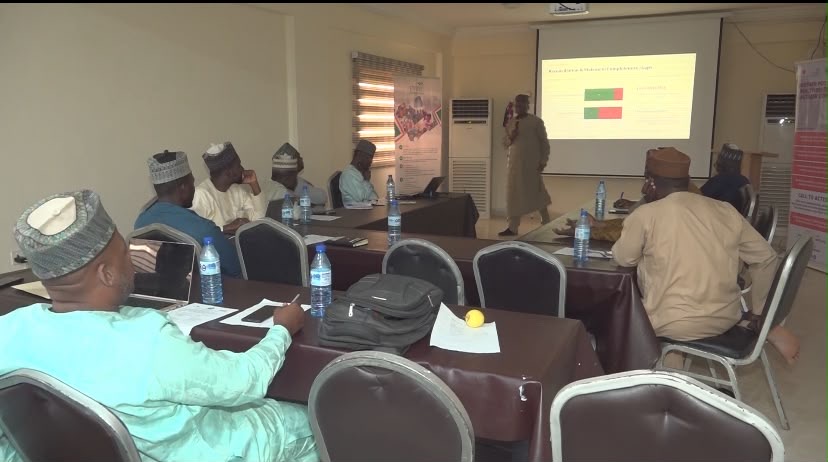
Stakeholders in Kano State’s primary healthcare sector have validated the findings of a pilot expenditure tracking exercise on the Basic Healthcare Provision Fund (BHCPF), identifying strengths in financial accountability while highlighting areas requiring urgent improvement to ensure more efficient use of the fund at the facility level.
The validation meeting brought together officials of the Kano State Primary Health Care Management Board, civil society organisations and development partners to review findings from a field assessment conducted in selected health facilities across Nasarawa, Tofa and Bunkure Local Government Areas.
Speaking during the exercise, the Kano State Lead for Lisdel, Dr. Muhammad Shuaib, said the expenditure tracking exercise was designed to provide a clearer understanding of how BHCPF resources are managed and utilised at the primary healthcare facility level.
According to him, 18 health facilities, six from each of the three selected local government areas were assessed as part of the pilot exercise.
He explained that while the Basic Healthcare Provision Fund has been implemented in Kano and across Nigeria for years, there has been limited understanding of financial accountability at the health facility level.
“This pilot is intended to give us a deeper understanding of how financial accountability works at the facilities. The findings will help inform future engagements and provide evidence for expanding similar exercises to more facilities with the support of other development partners,” he said.
Dr. Shuaib noted that preliminary findings from the assessment showed encouraging progress in financial management and governance practices under the BHCPF, although some critical gaps still need to be addressed.
He explained that the programme currently operates in apex primary healthcare facilities located in each of Kano State’s 484 political wards, in line with the national implementation guidelines for the Basic Healthcare Provision Fund.
According to him, while there may be opportunities to expand the programme in the future, the current implementation framework is based on one designated facility per political ward to strengthen access to primary healthcare services across the state.
Also speaking, the Programme Manager for the Basic Healthcare Provision Fund at the Kano State Primary Health Care Management Board, Nura Shariff, described the validation exercise as an important learning process that would help improve implementation across all participating facilities.
He said all 484 designated BHCPF facilities in Kano State currently have access to the fund and are utilising it, dismissing concerns that some facilities might have been excluded from the programme.
Shariff explained that the Board conducts routine supportive supervision and mentorship visits to monitor implementation, although the large number of facilities presents logistical challenges.
He said each local government has a BHCPF coordinator and an assistant responsible for conducting monthly supervisory visits, while the state team carries out monitoring exercises every quarter.
According to him, strengthening these routine supervision mechanisms will help improve the performance of facilities that are still lagging behind.
“The exercise has shown that while several facilities are performing excellently, others still require support in some areas. We are going to work with those facilities to ensure they improve and perform at the expected standard,” he added.
Representing civil society organisations at the meeting, Sagir Chedi of the Voice and Accountability Platform said the validation exercise was aimed at confirming whether the report reflected observations made during field assessments conducted between June and July.
While acknowledging that most facilities complied with the BHCPF implementation guidelines, he identified delays in the release of funds as one of the major challenges affecting implementation.
According to him, funds meant for the third quarter of 2025 were not released until January 2026, while allocations for the fourth quarter of the same year were only disbursed in May 2026.
He warned that such delays could affect service delivery at primary healthcare facilities and undermine the objectives of the Basic Healthcare Provision Fund.
Chedi also identified weaknesses in financial documentation, including poor archiving systems, the absence of bank reconciliation statements in some facilities and inadequate knowledge sharing between facility heads and their deputies.
He recommended continuous capacity building for facility managers on financial management, record keeping and the operational guidelines of the Basic Healthcare Provision Fund.
He also called for more comprehensive physical training for field assessors before future expenditure tracking exercises, saying this would improve data quality and ensure assessment tools are properly tested before deployment.
Stakeholders at the meeting agreed that while the pilot expenditure tracking exercise revealed encouraging signs of compliance and accountability, addressing gaps in fund releases, financial record management and supportive supervision would be critical to improving the effectiveness of the Basic Healthcare Provision Fund and strengthening primary healthcare service delivery across Kano State.