By Abubakar M. Kareto
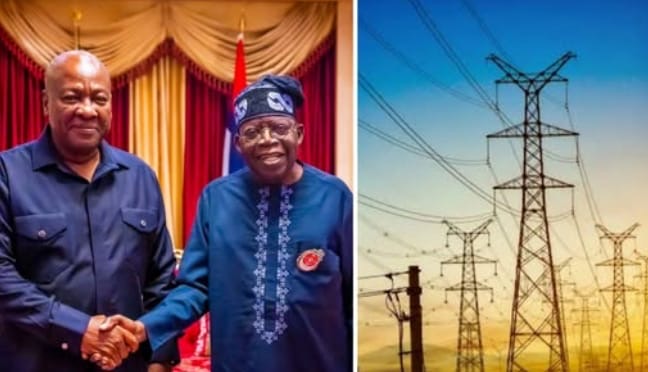
In the quiet calculus of West African geopolitics, electricity has replaced crude oil as the primary instrument of regional influence. When Ghana’s Energy and Green Transition Minister, Dr. John Abdulai Jinapor, announced at the US-Africa Nuclear Energy Summit that Accra is ready to supply electricity to Nigeria, the declaration signaled more than diplomatic goodwill. It marked a deliberate commercial effort to position Ghana as the power generation anchor of West Africa by capitalizing on deep operational disparities between the region’s largest economy and its most stable grid operator.
This initiative is built on cold arithmetic rather than surplus luxury. By the close of 2025, Ghana’s installed generation capacity reached approximately 5,840 megawatts, with dependable capacity standing at roughly 4,968 megawatts. Thermal plants account for nearly 70 percent of this fleet, hydro assets deliver 26 to 28 percent, and solar installations supply the remainder. While Ghana’s peak domestic demand rose from 3,500 megawatts in early 2025 to between 4,300 and 4,500 megawatts under the rollout of the government’s 24-Hour Economy agenda, supply planning remains aggressive. Accra has commissioned a 1,200-megawatt state-owned gas plant, with its initial 600-megawatt phase targeted for 2028, alongside concrete policy steps to integrate up to 1,000 megawatts of nuclear capacity into the national grid by 2030.
Nigeria presents a starkly different balance sheet. The country possesses between 13,000 and 14,000 megawatts of installed grid-connected capacity, yet average available generation has remained suppressed between 4,400 and 5,400 megawatts. Daily grid output routinely stagnates in the 4,000 to 5,000 megawatt corridor for a population exceeding 200 million people. Chronic gas shortages, unmaintained turbines, transmission bottlenecks, and distribution losses leave between 8,000 and 9,000 megawatts of installed generation entirely stranded. Roughly 85 million Nigerians remain completely cut off from the national grid. The resulting economic toll exceeds tens of billions of dollars each year, with commercial self-generation draining trillions of naira from private businesses. The industrial engine of Lagos State alone demands more than 6,000 megawatts, an amount greater than Nigeria’s entire national network manages to wheel on any given day.
Ghana already exports baseload power to Togo, Benin, Côte d’Ivoire, and Burkina Faso through the transmission lines of the Ghana Grid Company. Bringing Nigeria into that customer base scales up regional electricity trade by orders of magnitude. Nigeria is not merely another buyer; it is the prize market.
Four strategic objectives guide Accra’s policy.
The first goal is capturing first-mover dominance inside the West African Power Pool. With regional authorities accelerating toward unified grid synchronization and a competitive day-ahead market, securing high-volume cross-border delivery contracts with Nigeria gives Ghana substantial pricing power and control over regional wheeling routes. Across the Economic Community of West African States, electricity demand is projected to grow by more than 8 percent annually. Securing market share early ensures that Ghanaian generation assets run at optimal load factors.
The second goal is converting fuel constraints into commercial arbitrage. Nigeria sits atop Africa’s largest natural gas reserves but struggles to transport that fuel to domestic power stations. Ghana, having stabilized its domestic sector by clearing legacy independent power producer debts and enforcing disciplined Cash Waterfall revenue distribution, offers a proven conversion model. This stability opens the door for a cross-border swap mechanism: Ghana imports Nigerian natural gas feedstock, generates electricity in its modern thermal plants, and exports finished megawatts back across the border.
The third goal is financing domestic industrial expansion. Long-term initiatives like the 24-Hour Economy require steady capital to support new industrial parks, agro-processing clusters, and digital facilities. Exporting firm capacity to Nigeria generates vital foreign exchange, which strengthens the balance sheets of state-owned utilities and helps underwrite the capital expenditure needed for future gas and nuclear plants.
The fourth goal is providing the foundational test case for the African Continental Free Trade Area. With Accra serving as the seat of the trade secretariat, cross-border energy trade offers a practical demonstration of how single-market integration should function in practice. Industrial manufacturing across West Africa cannot expand without competitive, reliable baseload power. By treating electrical power as an openly traded primary input rather than a protected national asset, Ghana is positioning itself to supply the essential power required for factories across regional borders, effectively powering the wider free-trade zone from Accra.
Formidable physical and financial hurdles stand in the way. Delivering heavy commercial loads to Nigeria requires major upgrades to regional high-voltage transmission lines. Interconnector capacity across intermediate transit countries remains vulnerable to technical faults and unscheduled outages. Within Ghana, domestic peak demand could easily surge beyond current projections as industrial programs mature, narrowing the exportable margin.
Financial counterparty risk presents an equally serious challenge. While Ghana’s power sales to its smaller neighbors operate on predictable sovereign credit terms, Nigeria’s power sector is burdened by chronic liquidity shortages and collection deficits across its retail distribution companies. Without dedicated escrow accounts or multilateral payment guarantees from institutions such as Afreximbank or the World Bank, Ghanaian generators face unacceptable payment risks.
National political sensitivity in Abuja cannot be discounted. Successive Nigerian administrations have promised to establish the country as the manufacturing and energy giant of the continent. Formally purchasing electricity from a neighboring state one-seventh its physical size invites intense domestic criticism, especially with millions of Nigerian households still living without reliable power.
The proposal serves as an important test of whether West Africa can move past national protectionism to build an integrated regional energy market. The master plan of the West African Power Pool calls for tens of billions of dollars in cross-border generation and transmission investments. The long-term industrial trajectory of the sub-region will not be decided by who owns the largest untapped gas fields, but by which government can build reliable generation assets, manage utility liquidity, and maintain stable grid infrastructure. Accra has set out its terms, leaving Nigeria to choose between national pride and practical power supply.
Abubakar M. Kareto is a public affairs analyst, communications strategist, and political commentator specializing in governance, public policy, and socio-economic developments in Nigeria and beyond. He can be reached via amkareto@gmail.com or on X @amkareto.