By Abubakar M Kareto
In the complex governance landscape of northeastern Nigeria, post-conflict reconstruction is often judged by physical edifices, roads, and security presence.
While these physical indices are vital, the true metric of civil resilience lies in how a society protects its most vulnerable assets: human life and public wellbeing. For decades, Yobe State grappled with severe systemic deficits, high maternal and infant mortality indices, geographic isolation, and the lingering scars of regional insecurity.
Under Governor Mai Mala Buni, however, the state has undergone an institutional overhaul of its healthcare ecosystem, moving from fragmented emergency relief to a self-sustaining, multi-tiered clinical model.
The transformation across Yobe is not a product of cosmetic interventions; it is anchored on a two-pronged strategy: aggressive revitalisation of primary healthcare at the grassroots and simultaneous elevation of secondary and tertiary medical services to regional prominence.
At the foundational level, the Buni administration embarked on a deliberate policy to construct, renovate, and equip Primary Healthcare Centres across all 178 political wards in the state. This ward-level saturation systematically dismantled the tyranny of distance for agrarian and pastoral communities, ensuring that basic diagnostics, antenatal care, and childhood immunisations were accessible within immediate reach of every family.
This commitment received national and international validation when Yobe emerged as the overall National Champion in the Primary Health Care Leadership Challenge, outperforming all other Nigerian states to clinch regional and national honors backed by the Nigerian Governors’ Forum, UNICEF, and the National Primary Health Care Development Agency.
However, primary healthcare only flourishes when backed by capable secondary and tertiary referral pathways. This is where the expansion of Yobe’s clinical ecosystem represents a watershed moment in the state’s medical history.
Historically, complex surgeries and specialised care required patients from Yobe to embark on grueling, expensive journeys to Maiduguri, Kano, or Abuja. Today, the state has dismantled that dependency.
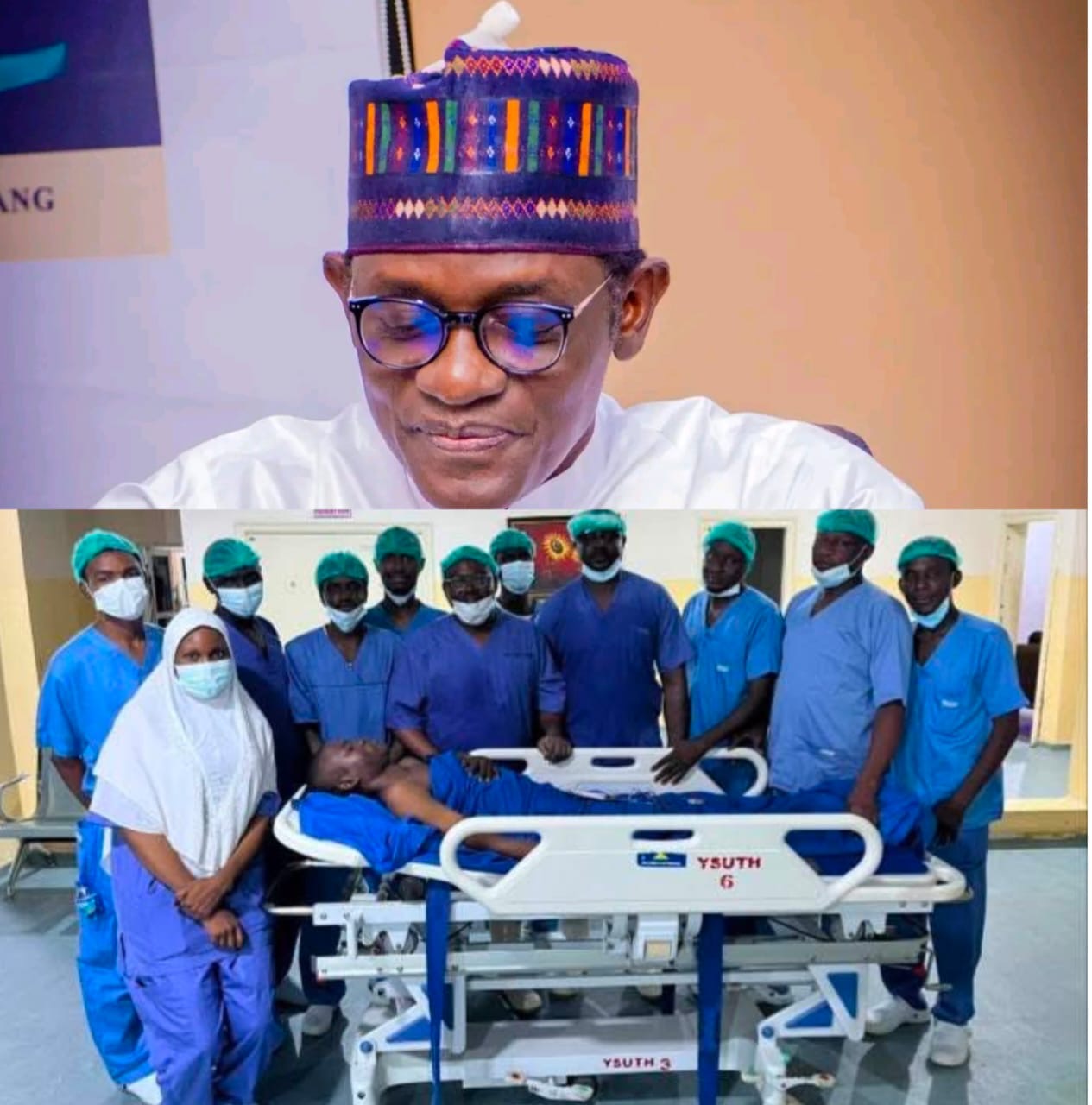
Under the guidance of Health Commissioner Dr. Muhammad Lawan Gana and the state government’s sustained capital backing, the Yobe State University Teaching Hospital recently achieved a landmark medical milestone: the successful execution of a total hip replacement surgery on a young sickle cell warrior afflicted with avascular necrosis of the femoral head. Led by orthopedic surgeon Dr. Lawan Musa Yari, alongside Dr. Musa Abdulmalik, Dr. Bashok Palagvi, Manasseh Jonah, and Karumi Ibrahim, the surgical team restored mobility and dignified living to a young citizen right inside Damaturu.
In a region where joint arthroplasty routinely costs millions of naira in private centers, delivering this delicate procedure within a state institution speaks volumes about theater readiness, surgical precision, and public subsidy.
This clinical sophistication is not an isolated occurrence at the teaching hospital. Across the state’s secondary healthcare tier, the Damaturu Specialist Hospital recorded an equally daring breakthrough by successfully performing an advanced maxillofacial reconstruction on a mother battling mandibular ameloblastoma, utilizing complex plate fixation and an iliac crest bone graft.
By becoming the first state-owned medical institutions in the entire North East sub-region to record these specialized orthopedic and maxillofacial feats, Yobe has transitioned from a healthcare consumer to an emerging referral destination.
Equally remarkable is the administration’s targeted response to local public health realities. Confronted with an unusually high prevalence of chronic kidney disease along the Yobe River belt, particularly around Bade, Nguru, and Gashua, the state established a dedicated Kidney Care and Dialysis Centre, offering heavily subsidised hemodialysis to alleviate the crippling financial burden on afflicted households.
Coupled with the construction of a 400-bed Maternal and Child Healthcare complex, free maternal and under-five healthcare policies, and the aggressive recruitment and training of hundreds of indigenous health workers, the administration has systematically tackled the structural roots of medical impoverishment.
Crucially, infrastructure alone does not save lives without intellectual capital. At a time when Nigeria’s medical sector is reeling from the devastating impact of professional brain drain, Yobe is actively reversing local vulnerabilities.
YSUTH’s recent accreditation by postgraduate medical colleges to train resident doctors in specialties like Community Medicine ensures that the state is actively cultivating, equipping, and retaining the next generation of home-grown specialists.
What makes Yobe’s health sector trajectory unique is administrative intentionality. Rather than scattering resources across disjointed political projects, Governor Buni recognised that human capital cannot exist without physical vitality. By linking rural dispensaries seamlessly to high-end surgical theaters in Damaturu, Yobe has demonstrated that sub-national governance, when steered with discipline and clarity, can turn a vulnerable frontier into a national benchmark for equitable healthcare delivery.
Abubakar M. Kareto is a Public Affairs Analyst and Communications Strategist. He can be reached on X @amkareto and via email at amkareto@gmail.com.