By Abubakar M. Kareto
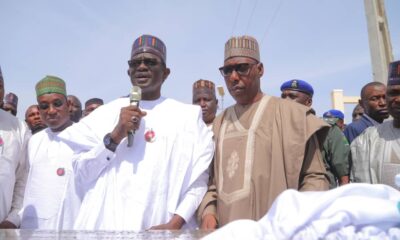
When His Excellency, Governor Mai Mala Buni, administered the oath of office to Dr. Mohammed Goje as the substantive Secretary to the State Government (SSG), the moment represented far more than a routine swearing-in ceremony. It marked the formal consolidation of a new administrative order in Yobe State, one anchored in technocratic rigor, deliberate mentorship, and generational succession.
In public administration, the transition from an acting capacity to a substantive mandate signals institutional stability. Replacing a veteran administrator of Alhaji Baba Mallam Wali’s caliber required a seamless policy transition, ensuring that the momentum of state governance remained uninterrupted as Wali moved on to political endeavors. By permanently placing the engine room of state administration in the hands of a proven specialist, Governor Buni sent a clear message that in the New Yobe, institutional performance is paramount, and executive trust is earned through verifiable results.
Institutionalizing Speed: Global Academic Depth Meets High-Stakes Field Execution
To understand why Dr. Goje’s confirmation has resonated across administrative and development circles, one must examine the specific capacity and track record he brings to the office. He is not a conventional political appointee; he is a scholar-practitioner whose career spans elite global institutions and high-pressure crisis coordination.
Elite Academic and Leadership Credentials
Dr. Goje holds advanced academic and executive credentials from institutions that shape international policy, including the Harvard Kennedy School and the London School of Economics. A Fellow of the Royal Society for Public Health (FRSPH), he holds a Master of Science in Epidemiology and Biostatistics from Universiti Putra Malaysia.
Furthermore, as a Fellow of the International Abshire-Inamori Leadership Academy at the Center for Strategic and International Studies (CSIS) in Washington, D.C., combined with study engagements in Japan and Pakistan, his professional toolkit was built specifically for complex policy design, sub-national stabilization, and post-conflict recovery across the Lake Chad Basin.
The SEMA Benchmark: Translating Crisis Management into Bureaucratic Efficiency
Before his elevation to SSG, Dr. Goje served as the Executive Secretary of the Yobe State Emergency Management Agency (SEMA). In a Sahelian region navigating post-insurgency recovery, disaster management is not a quiet administrative exercise; it is a life-or-death operation.
At SEMA, Dr. Goje transformed humanitarian response into a gold standard of public service by replacing fragmented emergency relief with precision data collection, ensuring aid reached vulnerable populations without leakages. He built seamless working relationships with the United Nations Office for the Coordination of Humanitarian Affairs (OCHA), international non-governmental organizations, and regional development partners, elevating Yobe’s credibility across borders. Rather than merely managing crises, he built resilient operational systems that survived individual emergency events.
What He Brings to the Engine Room
As substantive SSG, Dr. Goje transfers this exact crisis-tested efficiency to the macro-coordination of government. He brings to the state cabinet a high execution velocity, which is the ability to translate executive vision into rapid, time-bound policy implementation across all Ministries, Departments, and Agencies. He also provides diplomatic and fiscal deftness through deep international networking skills capable of attracting development partner investments and technical aid to complement state resources. Finally, he instills cross-sectoral synergy through a systematic approach to eliminating operational silos between ministries, ensuring healthcare, education, and security investments move in total alignment.
Elevating Governance Architecture: Talent Scouting over Political Patronage
While Dr. Goje’s capabilities are undeniable, his emergence is equally a testament to the visionary leadership of Governor Mai Mala Buni. Leaders are ultimately judged not only by the projects they commission, but by the caliber of human capital they discover, empower, and install in key institutions.
Meritocracy as a Policy Pillar
In many political settings, high-ranking administrative portfolios like the SSG are treated as political compensation. Governor Buni has consistently broken this mold, setting a benchmark for civil service reform in Northern Nigeria. His talent-scouting philosophy prioritizes competence, intellectual depth, and field experience over conventional political patronage.
By identifying Dr. Goje during his tenure at SEMA and systematically testing his capacities before assigning him the state’s highest administrative engine, Governor Buni demonstrated a rare quality in governance: the willingness to place high-stakes responsibilities in the hands of genuine specialists.
Active Mentorship and Institutional Trust
Governor Buni does not merely appoint young technocrats; he actively mentors them. His leadership style provides young appointees with the strategic backing required to execute difficult reforms while holding them strictly accountable for results.
Under Buni’s direct guidance, Dr. Goje was given the political cover and operational autonomy needed to modernize SEMA, a dynamic now being replicated across the entire state civil service. This mentor-mentee synergy creates total strategic alignment between the political head of state and the chief administrator.
Dismantling Barriers for the Next Generation
Across Northern Nigeria, youth inclusion has often been confined to symbolic roles. Governor Buni’s governance framework treats youth empowerment as a core operational strategy. From digital skills initiatives like BUNI Digital 6000 to the appointment of young professionals across boards, commissions, and cabinet positions, Buni is systematically cultivating a modern leadership vanguard.
At 45, Dr. Goje stands at the intersection of youthful vigor and seasoned experience. His elevation proves to the younger generation that rigorous preparation, integrity, and hard work will find a proud home in public governance.
Operationalizing Fiscal Capital for Lasting Impact
The confirmation of Dr. Goje alongside 15 senior Special Advisers, Permanent Secretaries, and Commission Chairmen represents the alignment of vision and execution at a crucial juncture for Yobe State.
As the state implements its 2026 Budget of Economic Growth and Infrastructural Transformation, allocating 62.7 percent of expenditure to capital development, the SSG’s office will serve as the central axis for fiscal discipline and monitoring. With over 9,230 new teachers recruited, 14,000 healthcare workers deployed, major capital infrastructure projects underway, and civil service capacity partnerships established with national institutes like ASCON and PSIN, Yobe State is building an enduring institutional legacy.
With Governor Mai Mala Buni providing the overarching strategic vision and Dr. Mohammed Goje managing the controls of the administrative engine room, Yobe State has established a compelling benchmark for modern, results-driven governance in Nigeria and across the African continent.
About the Author
Abubakar M. Kareto is a Public Affairs Analyst and Communication Strategist specializing in governance, political economy, and public policy dynamics across Nigeria and Africa. He can be reached directly via email at amkareto@gmail.com or on X (formerly Twitter) @amkareto