By Abubakar M. Kareto
When an operational minister leaves the policy suites of Abuja to inspect agricultural furrows abroad, the farming community takes notice.
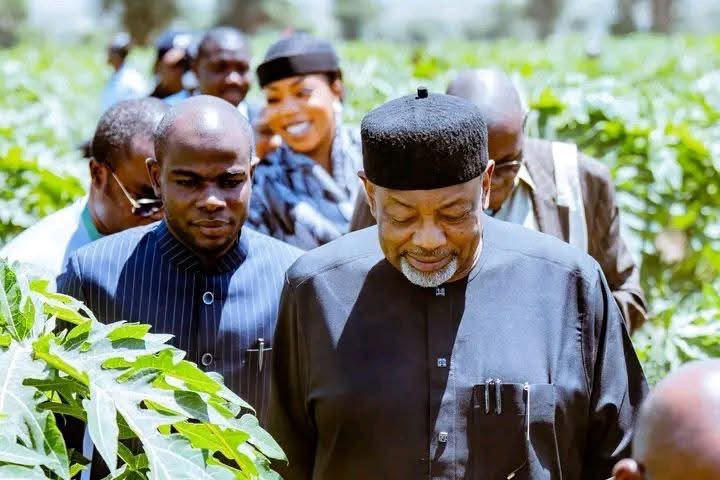
The presence of the Minister of Agriculture and Food Security, Senator Abubakar Kyari, CON, alongside Vice President Kashim Shettima across the irrigated plains of Oromia, Ethiopia, was not a ceremonial junket. It was a timely reconnaissance mission into the most successful wheat revolution on the continent.
For Nigeria’s farmers, seed producers, agro-processors, and flour millers, the timing could not be more critical.
The upcoming dry-season planting cycle is just weeks away. In northern Nigeria, wheat is governed by a rigid biological calendar: seeds must hit the ground between November and mid-December to capture the cool harmattan window before the scorching March heat aborts grain development. Miss that window, and yields collapse.
By examining Ethiopia’s irrigated clusters at this exact moment, Kyari has sought an actionable operational playbook right when Nigeria needs to deploy one.
The empirical gap between both nations explains the urgency. Nigeria consumes between 6.0 and 6.8 million metric tons of wheat annually, but domestic output languishes below 150,000 metric tons, stranding the nation in a crippling 95 percent import dependency.
Ethiopia faced an identical crisis five years ago, burning roughly $1 billion annually on imported grain. Today, through aggressive lowland irrigation and cluster farming, Ethiopia produces nearly 7 million metric tons, meeting its domestic demand and exporting surplus grain to neighbors like Djibouti and Kenya.
What, then, should Nigeria’s agricultural ecosystem expect from Kyari’s ministry upon his return?
First, wheat farmers should anticipate an end to scattered, isolated distribution and a shift toward structured cluster farming. In Oromia, Ethiopia abandoned fragmented smallholder handouts, grouping farms into contiguous 500- to 1,000-hectare irrigated blocks along river basins.
This consolidation enabled commercial tractor services to operate profitably, simplified canal water management, and allowed bulk input delivery. Kyari’s flagship vehicle, the National Agricultural Growth Scheme and Agro-Pocket, must now pivot from supporting geographically dispersed individuals to anchoring inputs around viable irrigation perimeters in the Hadejia-Jama’are, Sokoto-Rima, and Chad Basin corridors.
Second, the domestic seed value chain must prepare for accelerated commercialization. Ethiopia broke its yield ceiling, moving from 1.5 to over 3.5 metric tons per hectare, by mass-deploying certified, heat-tolerant seed cultivars suited to warm lowlands.
In Nigeria, domestic yields remain trapped around 1.2 metric tons per hectare, rendering commercial farming precarious.
Nigerian farmers must demand that Kyari’s ministry eliminate bureaucratic delays at the National Agricultural Seeds Council and properly capitalize institutes like the Lake Chad Research Institute to partner with private seed companies. Foundation seeds of proven heat-tolerant varieties must reach cooperative cold stores well before planting starts.
Third, commercial agribusinesses and industrial millers should expect enforceable backward-integration corridors. In Ethiopia, cluster farming succeeded because off-take was guaranteed; industrial millers were integrated directly with regional cooperatives under transparent purchase terms.
In Nigeria, the disconnect between millers in Lagos or Kano and farmers in Jigawa or Kebbi has long hindered local sourcing. By tying wheat clusters into the Special Agro-Industrial Processing Zones, Kyari’s ministry can offer processors real incentives: dedicated aggregation hubs, modern cleaning and drying facilities, and guaranteed domestic supply that protects them from foreign exchange volatility.
Finally, the mission’s strategic value lies in subnational coordination. Having key northern governors, such as Umar Namadi of Jigawa and Dauda Lawal of Zamfara, on the ground alongside Kyari addresses the historical divide between federal policy design and state land administration. Governors control land titles, local irrigation canals, and agricultural extension staff. Kyari’s joint tour with state executives lays the groundwork for federal input support to match state-level clearing of silted canals and deployment of agro-rangers to secure farming perimeters.
Senator Abubakar Kyari’s tour of Oromia has raised the stakes. Nigeria’s wheat farmers and agribusinesses do not need another round of Abuja policy communiqués; they need certified heat-tolerant seeds, functional tractor services, and dredged canals flowing into consolidated clusters. With the harmattan window approaching, the ministry has the blueprint in hand. The harvest will depend entirely on how rapidly and decisively Kyari executes.
Abubakar M. Kareto is a Public Affairs Analyst and Communications Strategist focusing on governance, policies, economy, and institutional reforms across Nigeria and Africa. He can be reached on X @amkareto and via email at amkareto@gmail.com.