By Abubakar M. Kareto
Public commentary across Nigeria continues to celebrate the dramatic expansion of Federation Account Allocation Committee disbursements as an undeniable marker of fiscal renewal. Moving from roughly ₦786 billion in mid-2023 to more than ₦2.3 trillion by mid-2026 offers the immediate optics of an unprecedented windfall. Yet this widespread cheer conflates aggressive currency devaluation with actual productive expansion. The real driver behind the surging Federation Account balances is exchange rate depreciation, not the organic creation of sovereign wealth.
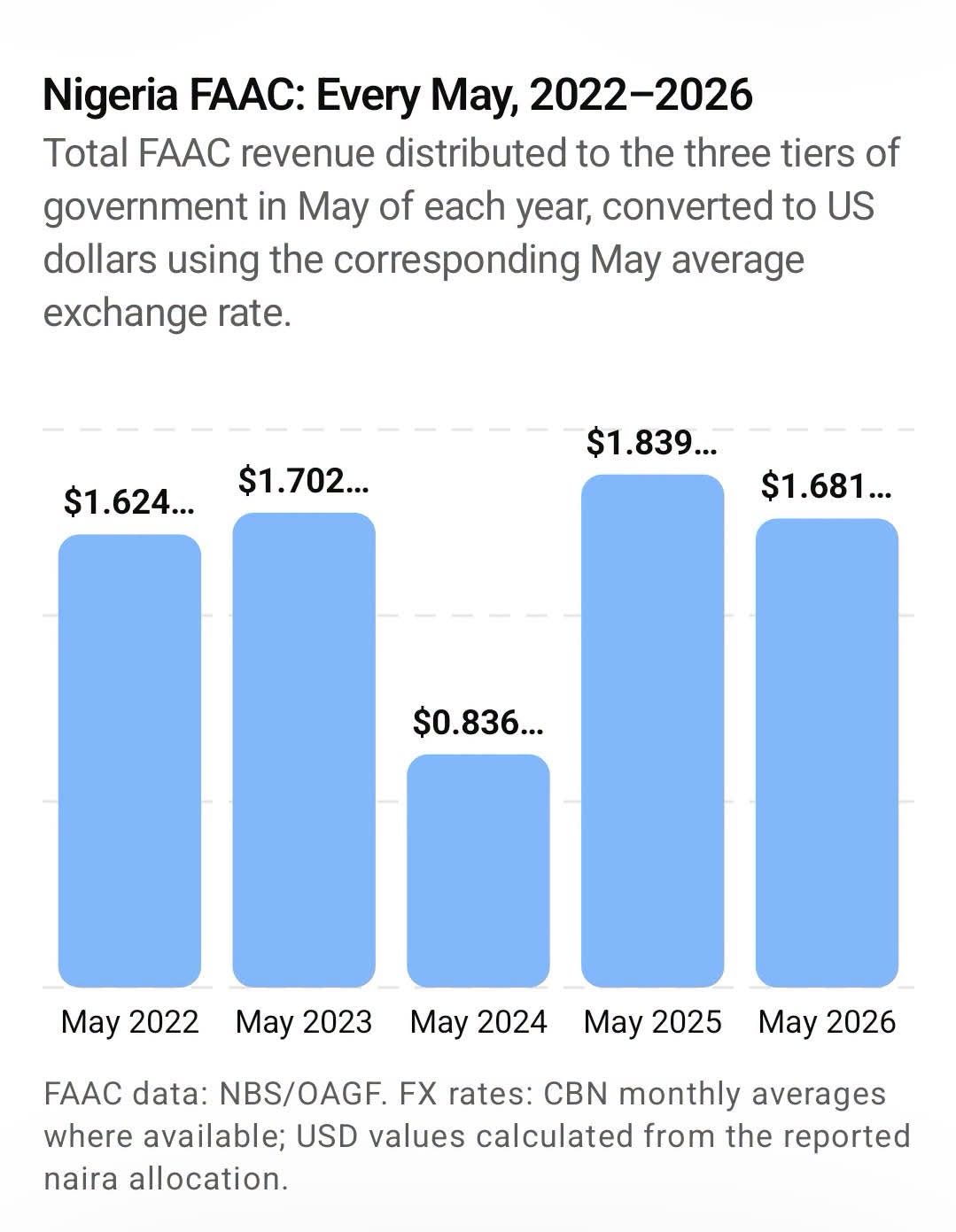
Assessing these disbursements in hard currency quickly dissolves the illusion. When converted to dollars, aggregate federation allocations remain essentially flat, and at points even lower than pre-reform benchmarks. The dramatic leap in nominal naira figures simply reflects the mathematical conversion of petrodollars and export-derived taxes at a much weaker domestic exchange rate. The federation is not distributing more value; it is merely sharing larger piles of paper currency that command significantly diminished real purchasing power.
This reality raises a fundamental question: if the costly petrol subsidy was discarded, why has the federation not recorded a substantial dollar-denominated revenue surge?
The explanation lies upstream within the hydrocarbon sector itself. The theoretical fiscal room created by terminating the consumer petrol subsidy was immediately offset by structural headwinds. Sub-optimal crude production quotas, deep operational deductions, joint-venture cash calls, and forward-sale crude-for-loan commitments have consistently intercepted oil revenues before they ever reach the federation account. Rather than entering public coffers as fresh dollar liquidity, the savings were largely absorbed by legacy financial liabilities and upstream inefficiencies.
At the sub-national level, the apparent solvency of state governments is largely sustained by a silent wealth transfer. Governors indeed distribute far more nominal naira, yet their largest recurrent liability, public wages, has shrunk in terms of actual economic value. Paying a newly negotiated ₦70,000 minimum wage today expends substantially fewer dollars of state value than settling the historic ₦30,000 threshold did under previous exchange dynamics. The enhanced fiscal breathing room enjoyed by state administrations is directly subsidised by the diminished purchasing power of the civil service.
Meaningful fiscal growth cannot be manufactured through foreign exchange translation. Until crude theft is genuinely curbed, upstream petroleum deductions are brought into full public accounting, and state revenues are anchored to internal productivity rather than currency degradation, the celebrated post-subsidy windfall will remain a ledger optical illusion.
By Abubakar M. Kareto
Public Affairs Analyst