By Zainab Ma’aji Abdul
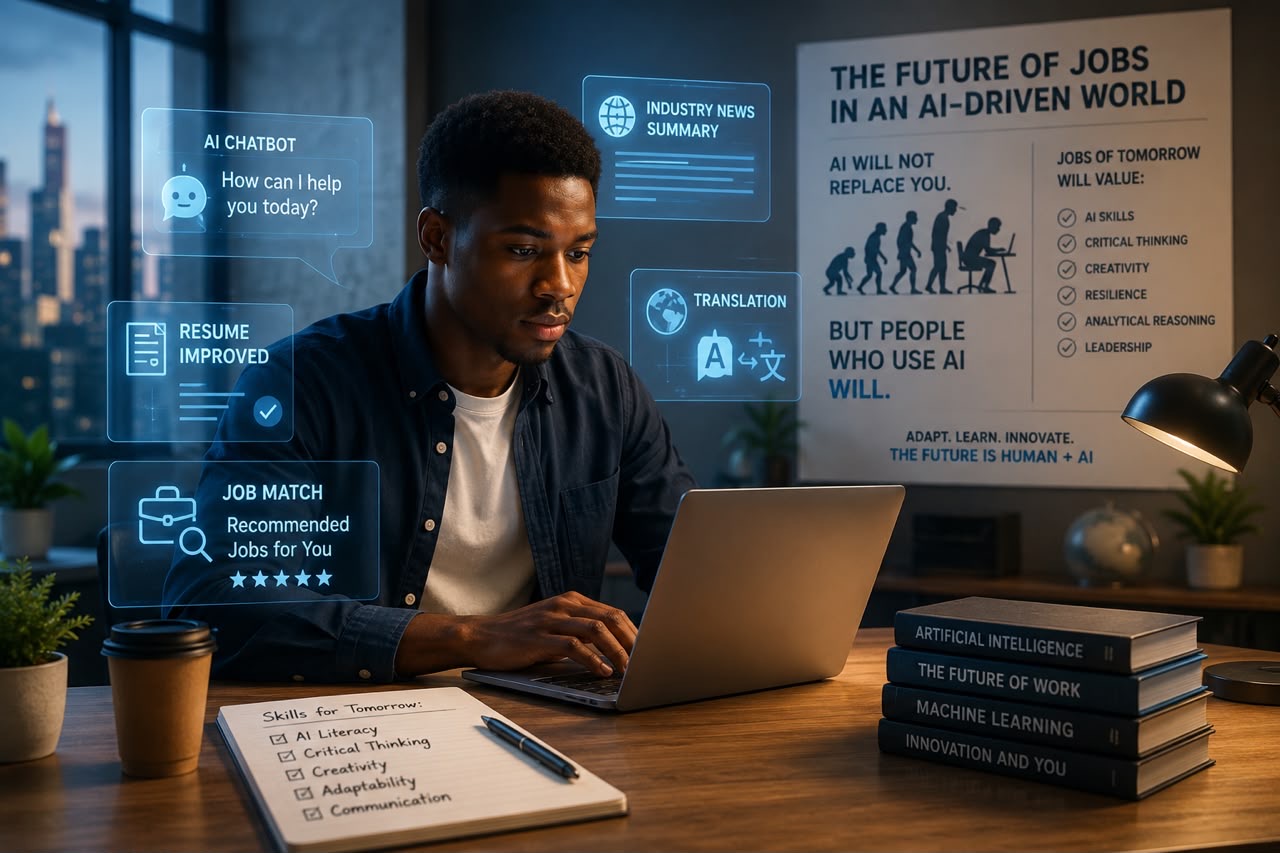
The alarm rings at 6:00 a.m., and Owolabi Daniel, a fresh university graduate, reaches for his phone. Before checking his emails, he opens an artificial intelligence (AI) chatbot. It helps him rewrite his résumé, improve his cover letter, and even recommends companies currently hiring. Moments later, another AI tool summarizes industry news while a translation application prepares him for an interview with an international employer.
Without realizing it, Owolabi has already worked alongside artificial intelligence before breakfast.
Just a decade ago, such a scene would have seemed like science fiction. Today, it is becoming an everyday reality. Artificial intelligence is no longer limited to research laboratories or technology companies. It writes reports, answers customer inquiries, assists doctors in diagnosing diseases, generates advertisements, edits videos, analyzes financial data, and even helps journalists conduct background research.
As AI continues to spread across industries, one question echoes through classrooms, offices, and boardrooms: Will artificial intelligence replace human workers, or will it redefine the future of work?
For many people, the rapid rise of AI is both exciting and frightening. Some fear that intelligent machines will take over millions of jobs, leaving workers unemployed. Others argue that AI will eliminate repetitive tasks while creating entirely new career opportunities. The reality appears to be more complex.
Throughout history, technological revolutions have changed how people work. The Industrial Revolution mechanized factories, reducing the demand for manual labour while creating new industries. The computer revolution automated office work but also gave birth to careers in software engineering, cybersecurity, digital marketing, and information technology. Artificial intelligence represents the latest—and perhaps the most powerful—phase of that transformation.
Unlike earlier technologies, AI can perform tasks that were once considered uniquely human. It can write articles, generate images, analyze legal documents, translate languages, summarize lengthy reports, and produce computer code within seconds. Consequently, occupations that involve routine cognitive tasks are becoming increasingly exposed to automation.
However, leading international organizations argue that the future of work is not simply about replacing humans with machines.
The World Economic Forum (WEF), in its Future of Jobs Report 2025, projects that 170 million new jobs will be created globally by 2030, while 92 million existing jobs will be displaced, resulting in a net gain of 78 million jobs. The report further estimates that 22% of today’s jobs will be transformed by 2030 due to technological advancements, demographic changes, economic pressures, and the green transition.
The report also found that employers increasingly value workers who possess AI-related skills alongside critical thinking, creativity, resilience, leadership, and analytical reasoning. Rather than competing against AI, future employees are expected to collaborate with it.
Similarly, the International Labour Organization (ILO), in its 2025 working paper, Generative AI and Jobs: A Refined Global Index of Occupational Exposure, reported that one in four jobs worldwide is potentially exposed to generative AI. However, the organization emphasized that exposure does not necessarily mean job loss. Instead, AI is expected to transform how work is performed by automating specific tasks while leaving humans responsible for judgment, creativity, interpersonal communication, and ethical decision-making.
Evidence of this transformation is already visible across multiple professions.
Teachers increasingly use AI to prepare lesson notes, generate quizzes, and personalize learning materials. Doctors employ AI-assisted software to detect diseases earlier through medical imaging. Lawyers use AI to review thousands of legal documents in a fraction of the time previously required. Journalists rely on AI to transcribe interviews and organize research while remaining responsible for fact-checking, verification, and ethical reporting.
In creative industries, graphic designers use AI to generate initial concepts before refining them with human imagination. Software developers employ AI coding assistants to write routine code while focusing on solving complex programming challenges. Farmers are beginning to use AI-powered tools to monitor soil conditions, predict crop yields, and improve productivity.
Nigeria is not immune to these changes. Banks increasingly deploy AI-powered chatbots to handle customer inquiries. Media organizations use AI to analyze audience behaviour and improve content recommendations. Telecommunication companies automate customer support, while educational institutions are gradually introducing AI-powered learning platforms.
Despite these opportunities, the AI revolution also presents significant challenges. Many young Nigerians graduate without adequate digital skills, while access to reliable internet, electricity, and modern computing facilities remains uneven. Without deliberate investment in AI education and digital literacy, the gap between technologically skilled workers and those without such skills could widen considerably.
The challenge is particularly relevant for university students. In many classrooms, success is still measured by the ability to memorize information. Yet employers increasingly seek graduates who can think critically, solve problems creatively, communicate effectively, and use emerging technologies responsibly.
The World Economic Forum also notes that technological literacy, AI and big data, cybersecurity, and analytical thinking are among the fastest-growing skills employers expect to demand by 2030.
This means universities may need to rethink how they prepare students for employment. AI literacy should no longer be limited to computer science departments. Students studying journalism, medicine, agriculture, engineering, law, business, and the social sciences all need to understand how AI is reshaping their professions and how to use it ethically.
Governments also have an important responsibility. Investment in digital infrastructure, internet access, research, innovation, and workforce reskilling will determine whether countries benefit from AI or fall behind in the global digital economy.
Ultimately, the debate should not focus solely on whether AI will replace people. A more pressing question is whether people are preparing themselves to work effectively alongside intelligent machines.
Back at his desk, Daniel receives an email inviting him for an interview. His résumé may have been improved by artificial intelligence, but it is his curiosity, communication skills, integrity, adaptability, and critical thinking that will determine whether he gets the job.
In the AI-driven workplace of tomorrow, technology may open the door, but human potential will still determine who walks through it.