By Abubakar M. Kareto
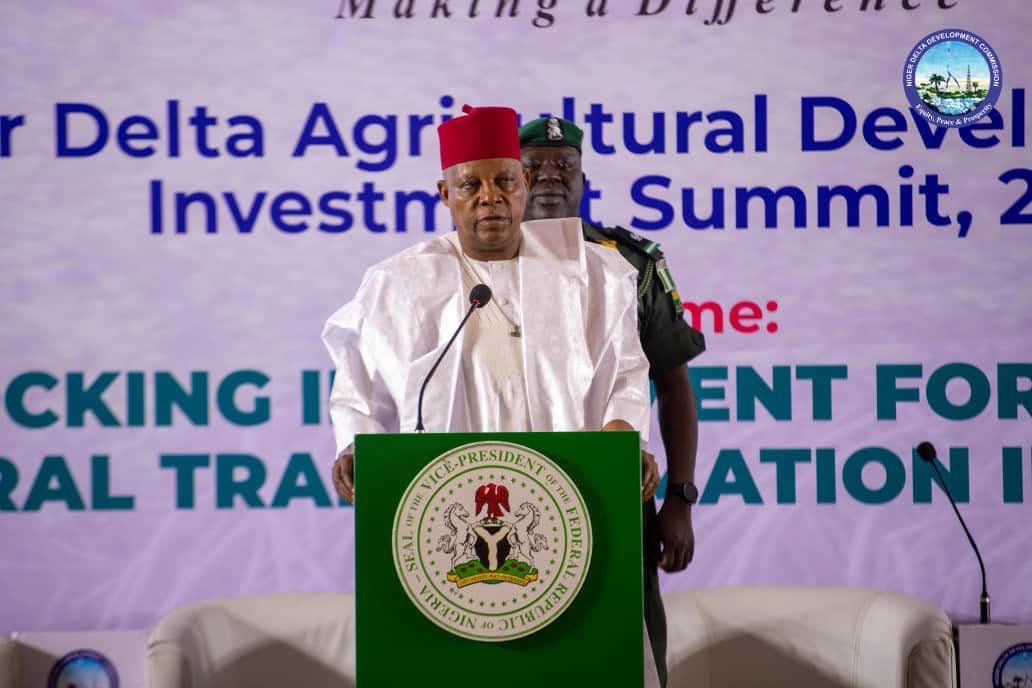
It is a profound validation of strategic public policy analysis when independent data aligns seamlessly with high-level executive oversight. When I recently characterized cassava as Nigeria’s “Neglected Goldmine,” I underscored a massive economic blind spot: our persistent failure to transition from a subsistence producer into a global industrial powerhouse. To hear Vice President Kashim Shettima take the podium at the Niger Delta Agricultural Development and Investment Summit and articulate these exact, verifiable structural realities proves a vital point: solving a national crisis begins with an accurate, shared diagnosis of the problem.
Vice President Shettima’s presentation was an intellectual masterclass, combining rare oratorical precision with deep macroeconomic insight. It is incredibly motivating to see a national leader eschew generic political rhetoric to confront the stark structural disparities that hold our economy back. By delivering hard truths with captivating, evidence-based rhetoric, the Vice President elevated the national discourse from simple crop farming to global value-chain economics.
The Stark Math of Value-Chain Economics
The core of the Vice President’s argument lies in a devastating comparative reality that highlights our lack of industrial processing capabilities. Consider the staggering opportunity cost: while the global market for agricultural derivatives expands exponentially, Nigeria remains a peripheral player on the financial margins of its own bounty.
Nigeria stands as the world’s largest cassava producer, harvesting an average of 66 million metric tons annually. Yet, due to low structural yields and an overwhelming reliance on domestic food consumption rather than industrial refining, Nigeria earns a fraction of its potential less than $1 billion USD in international revenue. In stark contrast, Thailand, the world’s second-largest producer, extracts between $3 billion and $5 billion USD from a significantly smaller harvest of only 26 million metric tons.
The secret to Thailand’s dominance is twofold: agronomic efficiency and industrial optimization. While Nigeria’s productivity languishes at an average of 6 tons per hectare due to a reliance on traditional methods, Thai smallholders leverage advanced farming techniques to maximize their soil. More importantly, Thailand aggressively processes its smaller yield into highly profitable industrial commodities such as modified starches, animal feed pellets, and chips primarily for premium international buyers.
The Vice President further illustrated this value gap by pointing to Indonesia’s palm oil paradigm. As an oil-producing state like Nigeria, Indonesia has successfully diversified its wealth, earning a staggering $45 billion USD in 2025 from 53 million tons of crude palm oil. By exporting 32 million tons of processed, value-added palm oil products rather than raw materials, Indonesia generated revenues that outpaced Nigeria’s entire oil revenue architecture. These figures demonstrate an uncomfortable truth: Nigeria does not have a production problem; we have an industrial processing and value-addition crisis.
Beyond the Soil: Unlocking the Blue Economy of the Niger Delta
A compelling highlight of the Vice President’s address was his strategic focus on the Niger Delta the third-largest delta in the world. For decades, this region has been viewed almost exclusively through the narrow lens of hydrocarbon extraction, falling victim to the classic resource curse. Vice President Shettima rightly re-centered the conversation around mariculture and the blue economy.
The Niger Delta is naturally endowed with vast aquatic resources uniquely suited for commercial aquaculture. The Vice President outlined an expansive roadmap for high-value marine farming, including:
1. Finfish farming targeting global delicacies like salmon, sea bass, and tuna.
2. Shellfish cultivation, including premium oysters, mussels, clams, and scallops.
3. Advanced crustacean production focusing on high-demand export commodities like shrimp, crabs, and lobsters.
As the Vice President profoundly noted, in a nation so richly endowed, we have no business being poor. There are regions in Nigeria where the ecological landscape is so fertile that proper investment feels akin to planting money and harvesting immense resource returns.
Continental Benchmarks: Instructive African Success Stories
To contextualize this vision, Africa already showcases remarkable examples of nations that successfully transitioned their agricultural sectors from basic farming to high-yield, industrial wealth creators, yielding massive monetary gains and profound GDP impacts:
Ghana’s Cocoa Processing Revolution: By implementing targeted policies to process raw cocoa beans domestically rather than exporting them raw, Ghana has captured a significantly larger share of the global value chain. The cocoa industry drives approximately $2 billion USD in annual foreign exchange earnings, making up between 8% and 12% of Ghana’s Gross Domestic Product (GDP). Local primary value addition shields the national economy from volatile raw-bean pricing while anchoring rural employment architectures.
Kenya’s Horticultural Export Architecture: Through advanced cold-chain logistics and rigorous international standards compliance, Kenya has transformed its fresh flower, fruit, and vegetable sector into a powerhouse value chain. The horticultural sector generates up to $1.2 billion USD annually in crucial foreign exchange, directly accounting for a staggering 33% of the nation’s total agricultural GDP and roughly 1.3% of its overall national GDP.
Morocco’s Green Morocco Plan (Plan Maroc Vert): Morocco systematically modernized its agricultural frameworks by deploying large-scale irrigation networks and encouraging private agro-industrial integration. The economic returns were swift, driving total agricultural export values to over $5.7 billion USD. By prioritizing high-value value chains, the program achieved a dramatic 6.9% average annual growth rate for agricultural value added, driving the entire agri-food sector to contribute an estimated 13% to 15% of Morocco’s aggregate GDP.
The Policy Roadmap: From Subsistence to Industrialization
This perfect alignment between independent policy analysis and executive focus is more than just a win for data accuracy; it is an inspiring catalyst for structural reform. By using his commanding platform to validate these precise metrics, the Vice President has turned a glaring structural deficit into an urgent, patriotic roadmap for investment.
To bridge this multi-billion-dollar revenue gap and tap into the global marketplace, Nigeria must aggressively pursue a three-pronged strategy:
1. Agronomic Optimization: We must urgently address the yield deficit. Agricultural policy must prioritize high-yield, disease-resistant stem varieties and modern farming techniques to push our output past the current sub-optimal thresholds.
2. Aggressive Industrial Processing: We must incentivize private capital to build local refining infrastructure. Nigeria needs to stop exporting raw commodities and start exporting high-margin derivatives like liquid starch enhancers, pharmaceutical binders, sorbitol, and bio-ethanol feedstocks.
3. Structured Public-Private Partnerships: The presidency and sub-national governments must actively derisk the agro-allied sector, providing dedicated economic zones, stable power supply, and streamlined export corridors for processed agricultural exports.
Conclusion
The analytical community and the presidency are reading from the exact same script. The diagnosis is flawless, the math is undeniable, and the path forward is perfectly clear. Nigeria must aggressively pivot from basic consumption to high-value industrial processing to finally claim its economic crown. Vice President Shettima has laid down the blueprint; it is now up to policymakers, investors, and stakeholders to turn these neglected goldmines into the foundation of a resilient, post-oil Nigerian economy.
Abubakar M. Kareto is a Public Affairs Analyst and Strategic Communication Strategist. He tracks governance transitions, national security frameworks, and macroeconomic policies across Nigeria, West Africa, and the African continent.
Email: amkareto@gmail.com
X (Twitter): @amkareto