By Abubakar M. Kareto
Nigeria’s governance narrative has long been crippled by a familiar fiscal theatre: massive appropriation bills that promise socio-economic transformation, yet yield nothing more than abandoned construction sites and unpaid contractors when the financial year closes. Year after year, state executives present grandiose budgets running into trillions of naira, complete with soaring rhetoric and lofty projections, only for citizens to inherit infrastructural stagnation. It is against this backdrop of habitual executive failure that empirical data released by Agora Policy regarding 2025 budget implementation forces a brutal, long-overdue national reevaluation of what subnational leadership actually demands.
At the epicenter of this performance paradox is Yobe State, a territory long burdened by severe security headwinds and constrained economic indices, which has somehow outpaced all thirty-five peers in capital budget execution. According to Agora Policy’s comprehensive analytics, Yobe recorded an astonishing capital budget execution rate of 106.4 percent, leaving Delta State at 99.9 percent and Lagos State—the nation’s undisputed commercial powerhouse—at 85.6 percent trailing in its wake. This statistical anomaly shatters conventional political economy assumptions, proving conclusively that administrative willpower, fiscal discipline, and strategic focus can effortlessly override structural disadvantages.
To fully grasp the weight of Yobe’s triumph, one must separate the political noise of recurrent spending from the tangible reality of capital expenditure. While recurrent budgets are swallowed by civil service overheads and administrative consumption, capital spending represents the concrete lifeblood of development, funding critical rural-urban roads, functional schools, modern healthcare facilities, and potable water schemes. Achieving an execution rate exceeding 100 percent signifies that the state administration did not merely exhaust its original appropriation; it actively mobilized supplementary resources mid-stream to ensure ongoing projects reached completion without stalling.
The most damning indictment of wealthier subnationals lies in Yobe’s revenue reality. In 2025, Yobe generated a modest 15.4 billion naira in Internally Generated Revenue, placing it near the floor of fiscal autonomy nationwide. Conversely, Lagos State amassed an unprecedented 1.85 trillion naira in IGR during the exact same window, eclipsing multiple states combined. For an economically constrained administration to outperform the nation’s financial capital in project delivery establishes an immutable governance truth: sustainable development is never a direct function of gargantuan wealth, but rather the strict byproduct of meticulous resource management, transparent prioritization, and absolute fidelity to public trust.
A broader scan of the federation reveals a deeply entrenched systemic malaise across the subnational landscape. While a select few states managed respectable capital performance, a staggering majority suffered catastrophic implementation failures. Subnationals like Taraba at 20.1 percent, Enugu at 23.7 percent, Plateau at 32.5 percent, and Kwara at 37.7 percent left more than sixty percent of their developmental appropriations unspent on paper while public infrastructure rotted in practice. These shocking deficits explain why citizens across diverse regions continue to endure impassable roads and dysfunctional public institutions despite governors broadcasting multibillion-naira budgets year after year.
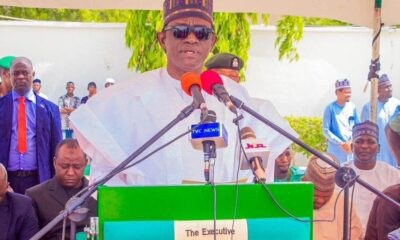
The credit for Yobe’s quiet revolution belongs squarely to the administration of Governor Mai Mala Buni, whose pragmatic stewardship has steadily steered the state away from insecurity toward administrative excellence. By institutionalizing transparency through regular, unvarnished publication of quarterly budget implementation reports in strict alignment with the Fiscal Responsibility Act, the Yobe State Government has cultivated an environment of accountability that commands respect. Governor Buni has demonstrated that proactive fiscal discipline can convert a historically marginalized state into a national benchmark for modern public service delivery.
This empirical wake-up call serves as a direct challenge to the endless excuses peddled by underperforming political officeholders across Nigeria. Citizens have grown weary of bloated appropriation figures and hollow political manifestos; they demand verifiable value for every public kobo expended. If a state operating on an austere revenue envelope can successfully execute over one hundred percent of its capital targets, then no executive governor possesses a valid excuse for leaving legacy projects half-built or entirely abandoned. Execution remains the sole, uncompromised metric of executive competence, separating visionary statesmanship from empty administrative posturing.
Ultimately, the Yobe model provides an indispensable blueprint for national renaissance as the political class looks toward future electoral accountability cycles. Nigeria will accelerate its trajectory toward sustainable growth only when budgetary allocations cease to be rhetorical exercises and transform consistently into physical assets on the ground. By proving that discipline and transparency can bridge the widest fiscal chasms, Yobe has challenged the entire federation to raise its standards, setting the definitive gold standard for governance in contemporary Nigeria.
Abubakar M. Kareto is a Public Affairs Analyst and Strategic Communications Specialist focusing on governance, political economy, and public policy across Nigeria and Africa. He can be reached via X (@amkareto) or email (amkareto@gmail.com).