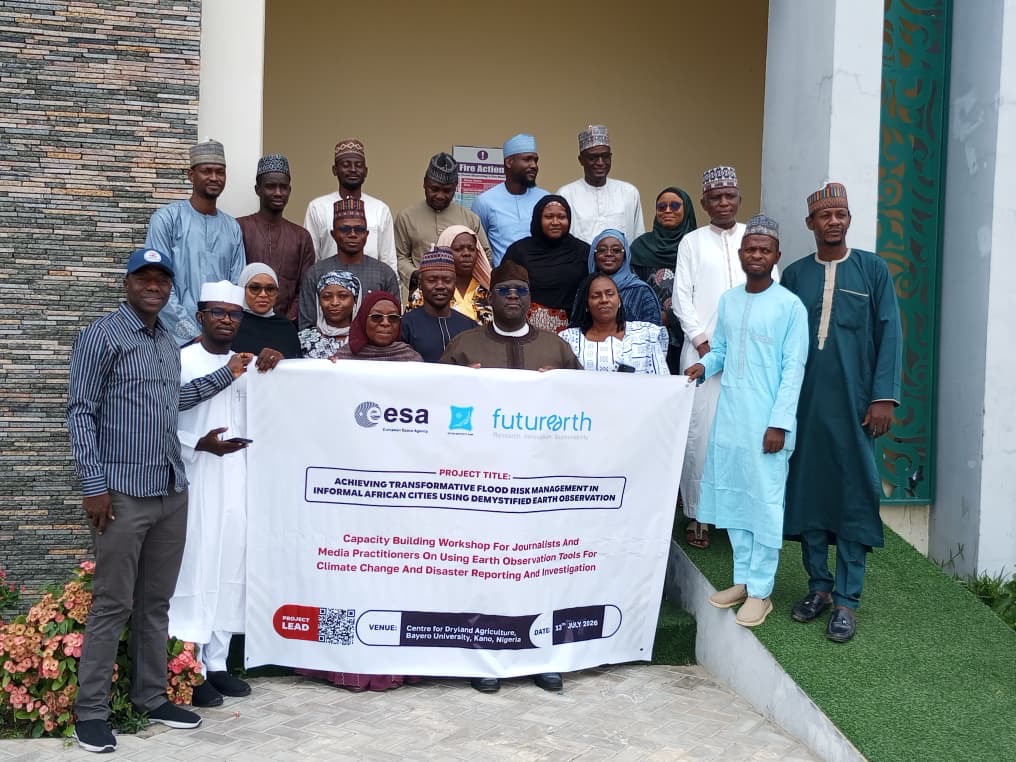
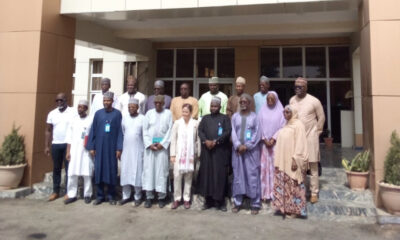
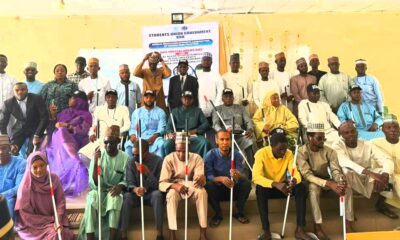
Bayero University Kano (BUK), in collaboration with the European Space Agency (ESA) has trained journalists and media practitioners with Earth Observation tools for climate change, disaster risk reduction and environmental reporting.
BUK, ESA in collaboration with Future Earth, capacity-building workshop is part of the project titled: “Achieving Transformative Flood Risk Management in Informal Flood Risk Management in Demystified Earth Observation”.
Speaking at the training on Monday in Kano, the Project Lead, Prof. Aliyu Barau, said the training was designed to improve evidence-based environmental journalism through the use of satellite imagery, geospatial data and remote sensing technologies.
Barau said environmental challenges such as floods, drought, land degradation, heat waves, deforestation and pollution were becoming more frequent, making accurate and timely information essential for informed decision-making.
He said Earth Observation technologies would enable journalists to move beyond anecdotal reports by providing reliable scientific evidence for investigative and data-driven reporting.
According to him, the tools can help reporters monitor flooding, land use changes, deforestation, urban expansion, drought conditions and environmental degradation with greater precision.
“The use of independent satellite imagery reduces reliance on anecdotal information and enhances the credibility and accuracy of news reports.
“These technologies also support fact-checking, investigative journalism and compelling visual storytelling that helps audiences understand environmental issues better,” he said.
Barau urged participants to collaborate with scientists, geospatial experts and policymakers to ensure that scientific knowledge was effectively communicated to the public.
He added that the workshop would also expose journalists to practical Earth Observation platforms and techniques for accessing and interpreting geospatial data.
Also speaking, the Deputy Vice-Chancellor (Research and Development), BUK, Prof. Amina Mustapha, said climate change remained one of the greatest challenges facing Northern Nigeria and the Sahel region.
She identified shrinking Lake Chad, desertification, drying rangelands and unpredictable weather patterns as some of the major environmental threats affecting livelihoods and food security.
Mustapha said journalists played a strategic role in translating scientific findings into stories capable of influencing public policy and promoting accountability.
She, however, observed that climate reporting in Nigeria often focused on global events while paying limited attention to local environmental challenges.
“The stories that deserve greater attention include the shrinking Lake Chad, the progress of the Great Green Wall initiative, displacement, food insecurity and loss of livelihoods caused by climate change,” she said.
Mustapha said the university remained committed to supporting journalists through access to its researchers, laboratories and research centres.
In a virtual address, the ESA Research Coordinator and Future Earth Liaison, Freya Muir, highlighted how earth observation technology can enhance climate modeling.
She said Earth Observation data generated through satellite missions provided actionable information for climate monitoring, disaster response and environmental management.
Muir said the information was processed into practical products that could support emergency response, climate research and public communication.
NAN reports that the workshop with the theme: “Earth Observation for Journalism, disaster risk reduction and climate change communication” featured technical presentations.
The presentations include “Introduction to Earth Observation for Disaster Risk Reduction and Climate Change Communication” and “Accessing Earth Observation Data for Evidence-Based Reporting “.
Participants were trained on the use of satellite imagery, geospatial platforms and digital tools to strengthen investigative journalism, disaster reporting and climate change communication.(NAN)