By Abubakar M. Kareto
When a politician who once stood on the verge of national leadership takes to the public square, citizens expect rigor, clear ideas, and constructive scrutiny. What they do not expect, and should never accept, is dragging national debate down to superstition, wardrobe policing, and dark, baseless smears.
I would have allowed Datti’s usual vituperations to slide away and defenestrate his ill thoughts. However, Nigeria, with its relatively young democracy, must firmly frown upon gutter politics. While I might not possess the power to halt Datti Baba-Ahmed’s obsession with a fellow politician and fellow Northerner’s charismatic persona, caution remains key in any decent political environment.
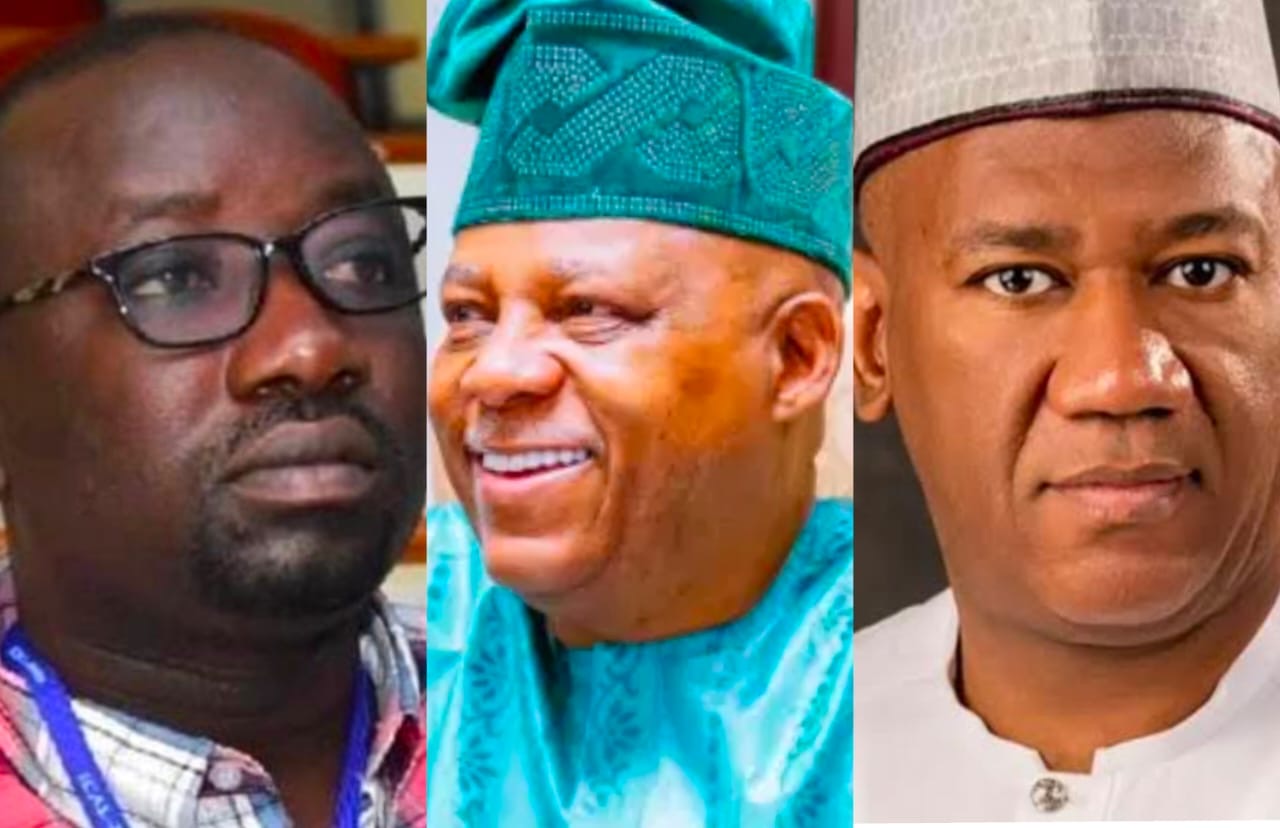
Senator Yusuf Datti Baba-Ahmed’s appearance on Seun Okinbaloye’s Mic On Podcast was an exhibition of political naivety and sheer pettiness. Instead of offering a coherent rebuttal of the administration’s economic direction or security policy, the former Labour Party vice-presidential candidate chose to major in trivialities: counting Vice President Kashim Shettima’s caps, conjuring shadowy marabouts, and whispering about border mysteries.
For a man who sought the second-highest constitutional office in the country, this descent into street gossip is not merely disappointing; it exposes a lack of temperament for serious governance.
The Petty Obsession with Cloth and Symbolism
Datti Baba-Ahmed’s primary complaint began with a trivial question: why does Vice President Shettima not wear President Bola Tinubu’s signature broken-shackle cap? In Datti’s telling, this is an anomaly so deep that only esoteric intervention can explain it.
Making headwear the test of statecraft demonstrates political immaturity. Shettima’s sartorial choice comes from his heritage. As a proud son of Borno, Shettima has worn traditional Kanuri caps for decades, maintaining a distinct cultural identity alongside his work in the presidency. Datti’s claim also collapses on the facts: Shettima has publicly worn the Tinubu cap on major occasions, especially during the 2022 campaign consultations.
Reducing party alliances and executive teamwork to an argument over embroidery shows a superficial view of power. Political offices rest on joint constitutional mandates, not sartorial subservience.
Weaponising Superstition and Border Tropes
Worse than the obsession with the cap was Datti’s reliance on superstition. By claiming that Shettima consults “marabouts” who instructed him to reject the president’s cap, Datti abandoned democratic debate for cultural dog-whistling.
In Northern political circles, invoking marabouts is an old tactic used to question an opponent’s faith and character. For an academic, economist, and university founder to stoop to this level insults the public. It tells citizens that even educated political actors will fall back on cheap slurs once substantive arguments dry up.
Datti then moved from superstition to reckless innuendo. He asked who Shettima’s “friends in those countries” are, what they do here, and why people go missing along the borders on election day.
These are not policy critiques. They are grave, unsubstantiated claims that exploit border sensitivities and regional tensions. If Datti possesses evidence of cross-border crimes or election violence, the proper step is to submit a formal petition to security agencies. Making theatrical remarks on a podcast shows a politician chasing viral clips instead of truth.
The Unravelled Insinuation and Shettima’s Restraint
This interview finally exposes the truth behind Datti’s earlier, theatrical claims on national television, where he declared that the airwaves could not carry what Shettima did. By bringing up spiritual interference, foreign operatives, and election malpractice on the Mic On Podcast, Datti revealed the hollow core of that buildup. He had no explosive national security revelation, only street rumors used to fuel a personal grievance against the Office of the Vice President.
The contrast with the Presidential Villa is telling. True to his calm, intellectual, and dignified nature, Vice President Kashim Shettima simply refused to follow him into the gutter. By staying silent and concentrating on governance, Shettima demonstrated executive maturity, proving that serious leaders do not trade slurs with political actors playing to the gallery.
Electoral Realities and the Art of Mobilisation
Perhaps someone needs to whisper some basic electoral truths into Datti’s ears: real politics is not played through endless noise or migrating from one podcast studio to another; it is anchored strictly on grassroots mobilization.
It remains a telling irony that a candidate who could not even win his own polling unit in Tudun Wada, Zaria, while running on the Labour Party presidential ticket, now spends his days throwing tantrums at a seasoned politician. Kashim Shettima was elected governor twice, went on to win a Senate seat, and subsequently secured the vice presidency. For Datti to substitute electoral work with bitterness exposes a startling gap between media performance and actual political value.
A Pattern of Inconsistency and Betrayal
In any case, taking Datti seriously has become nearly impossible for discerning observers. In a comical demonstration of political flip-floppery, Datti recently turned around to assert that his own principal in the 2023 general elections, Peter Obi, is incapable of fixing or leading Nigeria. The sole catalyst for this sudden realization appears to be their current dispersion into different political camps.
One is left to wonder: was Datti under a spiritual spell or blinded in 2023 when he traversed the country marketing Peter Obi as the ultimate savior of modern Nigeria? Or is he merely an artful dodger whose convictions expire the moment personal political calculations shift? To denounce the exact vehicle and principal you rode to national prominence exposes an erratic temperament. It lays bare a politician whose loyalties and assessments are not anchored on enduring principles, but on fleeting convenience.
Time to Heal and Move On
It is time for Datti Baba-Ahmed to finally move on. Yes, he aspired to the vice presidency on the Labour Party platform, but deep down he knows the truth: it was the Nigerian electorate that rejected his ticket at the ballot box, not Kashim Shettima. Nursing electoral wounds through endless bitterness, fabric paranoia, and border tales helps nobody. Even in fierce partisan politics, there should be a reasonable limit to post-election trauma.
The Demands of Statesmanship
Nigeria faces critical challenges that demand clear alternatives from the opposition. The country is working through major economic reforms, currency adjustments, energy demands, and regional security concerns across the Sahel.
The opposition must act like a credible government in waiting. That means challenging the presidency on farm productivity, capital budgets, civil service efficiency, and counter-insurgency strategy. When the opposition abandons that duty to argue about fabrics, caps, and fortune tellers, it fails the public.
Datti Baba-Ahmed’s remarks show the frustration of an unsettled ambition, delivered with the petulance of someone who cannot separate policy debate from market talk. Nigeria cannot afford these distractions. Those who want to lead this country must show that their focus remains on policy, law, and national development, not the whispers of political gossip.
About the Author
Abubakar M. Kareto is a Public Affairs Analyst, Commentator, and Communications Strategist focused on governance, policy, the economy, security, politics, and media dynamics in Nigeria and Africa. He can be reached via email at amkareto@gmail.com and on X @amkareto.