By Abubakar M. Kareto
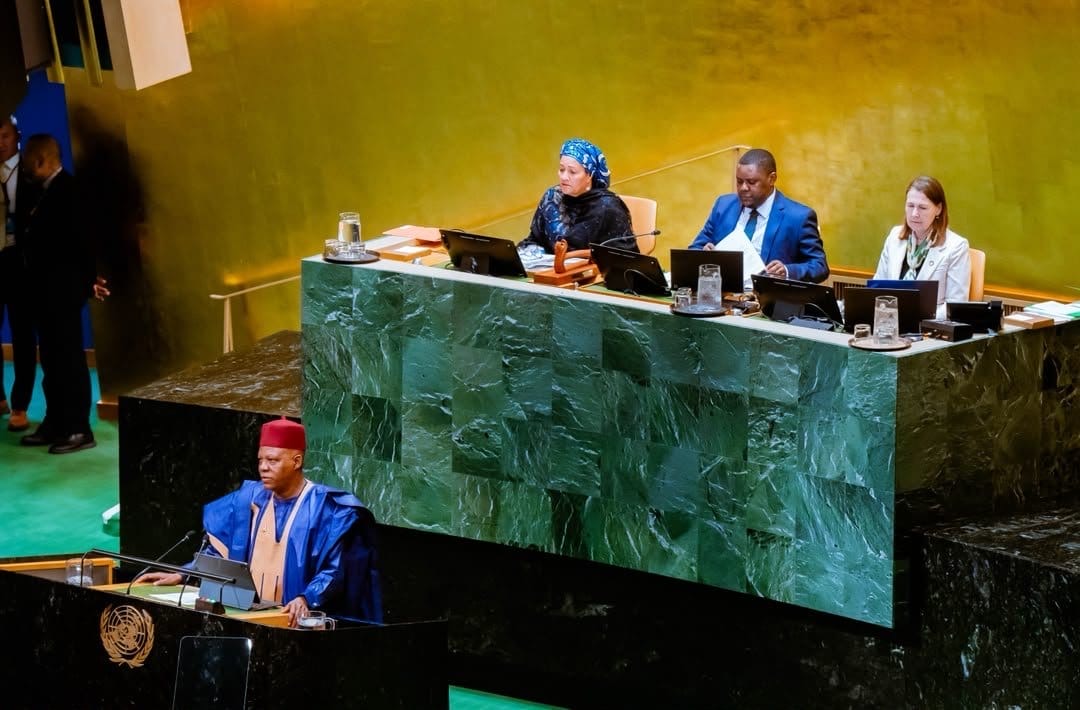
When Vice President Kashim Shettima mounted the green marble rostrum of the United Nations General Assembly in New York to deliver Nigeria’s national statement on behalf of President Bola Ahmed Tinubu, the diplomatic arena witnessed more than routine plenary rhetoric. The address at the 81st Session was an unapologetic recalibration of Nigeria’s foreign policy architecture. By seamlessly connecting domestic structural adjustments with high-level multilateral demands, Shettima moved Nigeria from a posture of passive consensus-seeking to strategic geopolitical assertiveness.
At the center of his discourse was an overdue confrontation with the post-World War II global order. His observation that the world of 2026 cannot remain captive to the distribution of power established in 1945 was a direct assault on multilateral inertia. Crucially, Shettima refused to compromise on the substance of African inclusion. Invoking the Ezulwini Consensus and the Sirte Declaration, he insisted that Africa’s demand for at least two permanent Security Council seats must include every prerogative currently enjoyed by the permanent members, specifically including the right of veto for as long as that mechanism exists, alongside five non-permanent seats. In doing so, he dismantled patronizing international proposals that offer Africa ceremonial permanent seats without equal voting weight, asserting that equality in global governance cannot be rationed.
Shettima grounded this institutional demand in Nigeria’s extensive record of regional sacrifice. In diplomatic negotiations, moral authority requires operational proof. By recounting decades of blood, treasure, and technical deployment across Liberia, Sierra Leone, Darfur, Mali, and The Gambia, the Vice President offered hard evidence of Nigeria’s continental leadership. This record of sacrifice counters the notion that leadership on the Security Council is solely the preserve of economic wealth or nuclear capability. It establishes that the nations consistently underwriting regional peace and conflict mediation through bodies like ECOWAS and the African Union are foundational to global stability.
A compelling dimension of the address was the tactical link drawn between domestic economic reforms and foreign trade strategy. Too often, foreign policy in developing economies exists in an intellectual vacuum separated from domestic fiscal reality. Shettima bridged that divide. He contextualized the administration’s macro-economic reforms, private sector mobilization, and fiscal adjustments not as isolated national struggles, but as deliberate steps to build resilience within the global market. He framed the African Continental Free Trade Area as a structural solution to historical inequities, declaring that Africa must graduate from being an exporter of raw minerals to an engine of industrial manufacturing, knowledge exchange, and integrated regional value chains.
This economic realism extended directly into an indictment of the international financial architecture. Shettima directly challenged the structural trap facing the Global South, where nations are forced to spend disproportionate shares of their national revenue servicing external debt at the expense of healthcare, basic education, and critical public infrastructure. By demanding systemic reform of multilateral lending, wider access to concessional financing, and debt sustainability frameworks tied to developmental outcomes, he elevated debt sovereignty into a core foreign policy issue.
On climate policy, Shettima dismantled prevailing Western orthodoxies with equal firmness. He rejected the false binary imposed on developing nations between aggressive climate targets and economic survival. While Africa accounts for less than 4% of global greenhouse emissions, it bears the most severe ecological consequences. Shettima’s reaffirmation of Nigeria’s 2060 Net Zero target within an equitable energy transition framework—safeguarding natural gas as a vital transition fuel—defended Africa’s sovereign right to industrialization. In his framing, climate action without equitable financing mechanisms, technology transfer, and structural debt relief amounts to an abdication of shared global responsibility.
Technological equity emerged as another core pillar of the address. Addressing the rapid expansion of Artificial Intelligence, Shettima warned against allowing geopolitical anxiety and technological protectionism to dictate the future. Utilizing a memorable metaphor, he noted that a knife can take life in the hand of an assailant or preserve it in the hand of a surgeon. By pitching Nigeria’s youthful population, expanding broadband investments, and digital public infrastructure to global investors, he reframed the country from a passive consumer of foreign digital disruption into an inventive producer of technological solutions.
On matters of global peace and security, Shettima drew directly on the hard lessons of the Boko Haram and ISWAP campaigns in the Lake Chad Basin. Governed by his background on the frontlines of subnational crisis management, he cautioned that military strength without durable social foundations—education, economic inclusion, and accountable institutions—cannot secure lasting victory.
Nowhere was his moral clarity more piercing than in his assessment of contemporary humanitarian crises in Sudan and the Middle East. Stripping modern warfare of its diplomatic pretenses, he declared that no claim to security can ever justify starving children, denying relief to trapped civilians, or erasing communities from the land they call home. It was an uncompromising affirmation that international humanitarian law cannot be selectively applied depending on which flag flies over the battlefield.
His closing declaration that humanity is our oldest citizenship and peace is the inheritance owed to every child served as an ethical imperative for a fragmented world. Vice President Kashim Shettima’s performance at UNGA 81 was not an ordinary diplomatic outing; it was a compelling demonstration of parallel statecraft. It proved that when national leadership pairs intellectual precision with strategic clarity, Nigeria does not merely occupy a seat at the global table, it actively helps reshape the agenda.
Author Bio
Abubakar M. Kareto is a Public Affairs Analyst and Communications Strategist focusing on governance, policies, economy, and institutional reforms across Nigeria and Africa. He can be reached on X @amkareto and via email at amkareto@gmail.com.