By Abubakar M. Kareto
When the gavel signals the commencement of the General Debate of the 81st Session of the United Nations General Assembly in New York, the green marble hall will confront an avalanche of scripted diplomatic niceties. Modern multilateral diplomacy too frequently retreats into safe, technocratic prose engineered to offend no one, appease everyone, and resolve very little. Yet, when Vice President Kashim Shettima mounts the rostrum to deliver Nigeria’s national statement on the mandate of President Bola Ahmed Tinubu, the assembly should anticipate a decisive break in routine. In an era dominated by focus-grouped soundbites, Shettima remains a deliberate outlier: a leader who treats the diplomatic podium not as a teleprompter for consensus, but as a platform where national interest is hammered into moral principle.
The 81st UNGA convenes under a significant rubric: “Restoring trust, managing transformation: A United Nations that delivers for all.” To the developed capitals of the Global North, restoring trust often reads as an abstract ethical aspiration. To the Global South, and Africa in particular, trust is a broken multilateral contract. It is an overdue debt owed to sovereign nations continually expected to underwrite global stability while locked out of its governing rooms. Few leaders possess the philosophical depth and directness to deconstruct this asymmetry quite like Shettima, whose public interventions routinely discard ceremonial decorum in favor of structural truth. In New York, his brief is to interrogate an international system that demands compliance without equity.
Trust cannot be restored while the global financial architecture penalizes developing economies through extortionate risk premiums disconnected from domestic fiscal discipline. These inflated borrowing costs compel African governments to deploy massive shares of revenue into debt servicing at the direct expense of education, healthcare, and infrastructure. Expect Shettima to confront the Bretton Woods institutions without ambivalence: not begging for the relief of temporary debt suspension, but demanding an overhaul of sovereign risk assessment frameworks, predictable liquidity access, and an end to fiscal conditionalities that choke domestic growth and sovereignty.
This financial critique directly underpins the ecological crisis. From the advance of the Sahara Desert and the shrinking basin of Lake Chad to the catastrophic flooding choking Nigeria’s agricultural belts, the nation bleeds economically from disruptions it did not cause. The Vice President’s expected interventions on the Right to Development and climate finance will challenge the prevailing paternalism of global summits. It is insufficient for industrial polluters to celebrate the creation of Loss and Damage funds; these facilities must cease being repackaged as interest-bearing loans and be disbursed as rightful, untied climate justice.
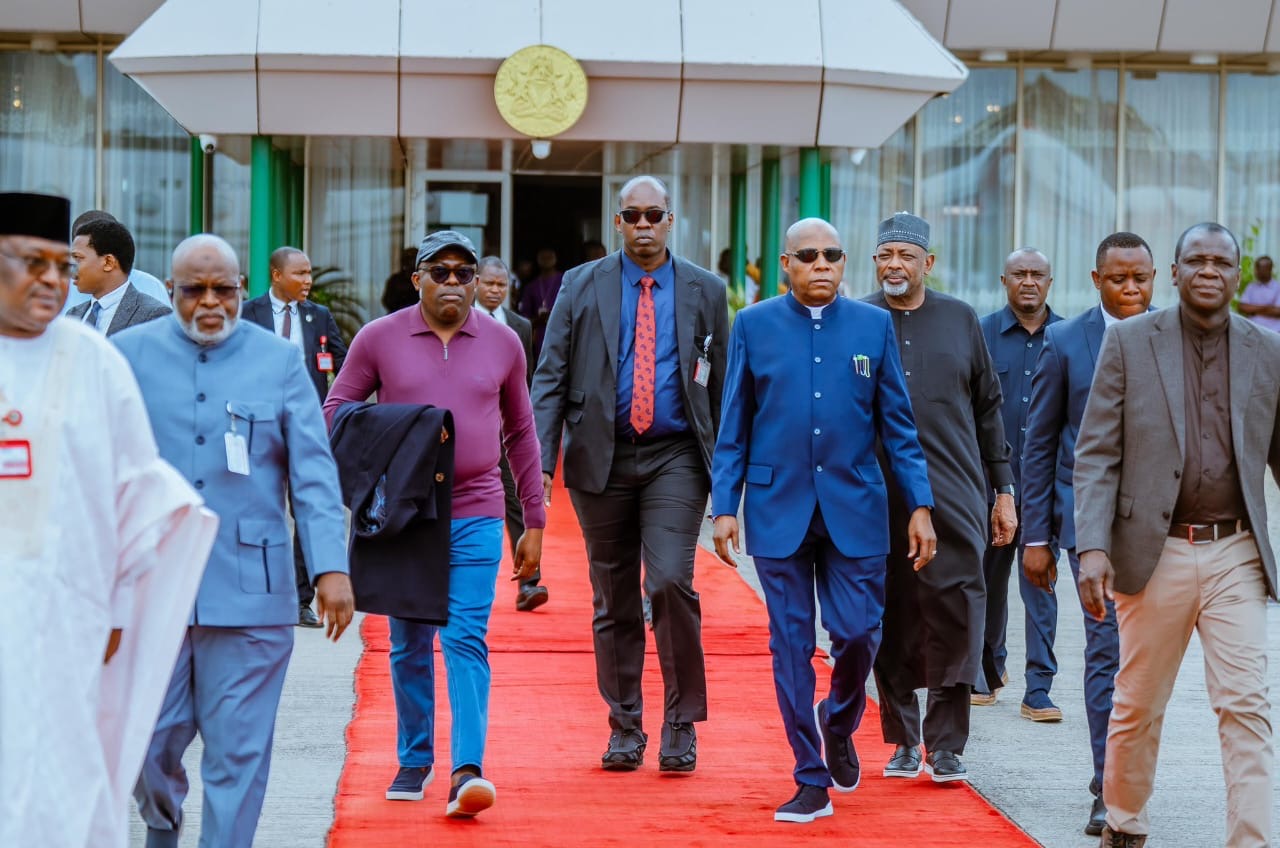
Yet, what elevates Nigeria’s mission at UNGA 81 from rhetoric to practical statecraft is the calculated composition of the delegation. Joining the Vice President are sub-national chief executives, notably Governor Siminalayi Fubara of Rivers State and Governor Dauda Lawal of Zamfara State, alongside senior cabinet ministers. This deliberate synthesis of federal authority and sub-national economic custodians marks a maturation of Nigerian economic diplomacy, moving multilateral engagement away from ceremonial posturing and directly toward tangible investment outcomes.
On the margins of the General Assembly, where sovereign capital and multinational enterprise intersect, policy yields to balance sheets. Governor Fubara’s presence places the operational realities of the Niger Delta—the heart of Nigeria’s hydrocarbon output, port logistics, and blue economy—directly into bilateral rooms with energy transition investors. Concurrently, Governor Lawal’s inclusion brings Zamfara’s critical mineral wealth into strategic focus, establishing a firm posture: Nigeria is no longer an open quarry for raw extraction, but an economy requiring domestic value addition, processing, and technology transfer. In Shettima, these state executives find an authoritative federal anchor capable of weaving regional strengths into a coherent national narrative.
Beyond commerce, Shettima carries the mantle of an assertive, non-aligned regional leader. West Africa sits at a tense geopolitical crossroads, facing democratic instability across the Sahel, protracted insurgencies, and external actors vying for strategic footholds. The Vice President will project Nigeria’s foreign policy posture: one that welcomes constructive, mutual partnerships while resolutely rejecting clientelism. Crucially, his voice will amplify Africa’s urgent demand for permanent representation on the United Nations Security Council, reiterating that an institution operating on the 1945 post-war order, which sidelines 1.4 billion Africans, cannot credibly claim to deliver for all.
From September 22 to 28, the world will listen to heads of state and delegates step onto the global stage. Kashim Shettima will not deliver a defensive report or a routine diplomatic laundry list. He will deliver a clear position: that transformation cannot occur without equity, that trust cannot be demanded where fairness is denied, and that an international order that continues to marginalize the Global South will ultimately fail to secure stability for the wider world.
Abubakar M. Kareto is a Public Affairs Analyst and Communications Strategist focusing on governance, policies, economy, and institutional reforms across Nigeria and Africa. He can be reached on X @amkareto and via email at amkareto@gmail.com.