Abubakar M Kareto
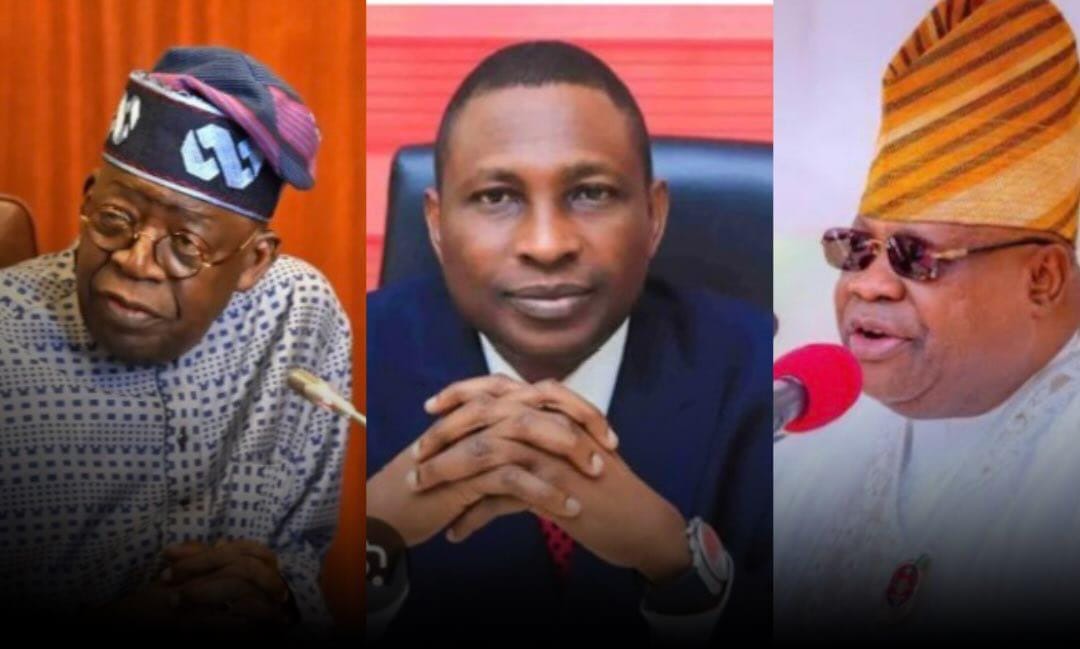
The political situation unfolding in Osun State ahead of the August 2026 governorship election has brought Nigeria’s democratic institutions to a critical point. The Economic and Financial Crimes Commission decided to freeze the bank accounts of the Osun State Government over an alleged eleven billion Naira financial probe involving Ecology Funds, Intervention Funds, and Federal Account Allocation Committee allocations. This was followed quickly by a direct Presidential directive ordering the agency to vacate the restriction. These events highlight serious questions regarding the administration of justice, executive powers, and institutional neutrality.
While the anti-graft agency presents its move as a preventive measure against the sudden movement of public funds, the timing, procedural gaps, and subsequent executive reversal raise fundamental questions. Can an institution be genuinely independent if its judicial processes can be halted by executive instruction whenever they become politically inconvenient?
The primary contradiction lies in the rhetoric versus the reality of executive authority. In his official statement, President Bola Ahmed Tinubu reaffirmed a commitment to institutional autonomy, asserting that law enforcement agencies must act without fear or favour, or political interference. Yet, in the same breath, the President issued an explicit directive instructing the commission to proceed to court immediately to vacate the order and discontinue its action.
Looking at the sequence of events, the anti-graft mandate led directly to the account freeze as a preventive measure, while the executive directive resulted in a mandated vacatur as political recourse. This duality creates clear tension. If the commission acted lawfully under its statutory mandate, the proper place to resolve issues of timing or public interest is the court, since overriding an active court-backed process through executive command undermines the separation of powers. Conversely, if the commission acted improperly or politically, halting the action purely because of bad timing rather than legal merit suggests that anti-corruption enforcement depends on political schedules instead of legal rules.
A clear discrepancy emerges when analyzing the operational timeline. In its initial press statement, the commission cited its preventive mandate and the placement of a Post No Debit order to stop suspicious transfers into corporate entities. Under Section 6(5)(b) of the Money Laundering Prevention and Prohibition Act, the commission possesses administrative powers to place a temporary seventy-two hour stop order on accounts under active investigation. However, extending such restrictions indefinitely without an order from a competent Federal High Court, as stipulated under Section 34(1) of the Economic and Financial Crimes Commission Establishment Act 2004, exceeds administrative authority.
The subsequent State House release explicitly references a court order obtained on August 5, 2026. This sudden shift in the narrative raises critical procedural questions regarding whether the agency acted administratively first and obtained an order after the fact, or if the presidential reference to a court order was a way to frame what began as an administrative freeze. Similar legal friction was witnessed during the 2018 Benue State account freeze controversy, where the Federal High Court in Makurdi initially barred emergency account restrictions on state accounts before the Court of Appeal in 2022 clarified the strict statutory boundary allowing a seventy-two hour administrative hold while requiring judicial sanction for extended freezes. When anti-graft agencies freeze the main operational accounts of a state government right before an election, clear proof of due process is essential.
In democratic governance, how actions appear is just as important as the facts behind them. Conducting an investigation since March 2026 only to freeze accounts ten days before a governorship election leads to accusations of political targeting. Similar historical patterns emerged in previous election cycles, such as the 2018 pre-election account restrictions in opposition-led states, showing that these recurring enforcement timing issues risk damaging institutional neutrality across successive administrations.
As noted in the public response by political figures like Peter Obi, freezing a state’s main bank accounts right before an election risks stopping basic government functions and affecting the fairness of the vote. Beyond political debate, shutting down sub-national operational accounts creates severe socio-economic consequences by paralyzing civil servant salary payments, pension disbursements, emergency healthcare operations, and state-level election security logistics. Even if the commission had legitimate evidence regarding fund transfers, taking such action right before an election creates a situation where federal law enforcement agencies appear to be taking sides.
The anti-graft agency focuses primarily on protecting eleven billion Naira in public funds from sudden transfers, yet taking action ten days before an election after months of quiet investigation creates negative public perception. The presidency emphasizes protecting electoral credibility and public trust, though direct executive intervention contradicts statements about non-interference. Meanwhile, the Osun State government and opposition parties prioritize protecting constitutional federalism and electoral fairness, while the state government still needs to clearly account for the reported movement of funds to corporate entities.
Under Sections 120 and 121 of the 1999 Constitution of the Federal Republic of Nigeria, state governments maintain constitutional financial autonomy through their respective Consolidated Revenue Funds. Furthermore, Sections 125 and 128 vest primary oversight of state public expenditure in State Houses of Assembly and State Auditors-General. While state officials are not immune from criminal investigation for financial wrongdoing, shutting down an entire state government’s financial machinery through an administrative or sudden freeze directly impacts the delivery of essential public services and the payment of civil servant salaries.
When executive directives replace court processes, the rule of law is weakened. If an anti-graft agency’s court action can be stopped by the President because of political timing, it implies that the application of anti-corruption laws is optional rather than consistent.
To prevent this situation from happening again, Nigeria’s governance system requires clear safeguards. Emergency account restrictions on state governments must follow clear court reviews in open court rather than unilateral administrative orders. Statutory guidelines should establish a moratorium or elevated judicial threshold for broad account freezes on state operational treasuries within thirty days of an election unless endorsed by a full panel of the Federal High Court. Furthermore, the leadership of anti-corruption agencies needs true operational independence so that their actions are neither started by political requests nor stopped by presidential orders.
The Osun State account freeze situation shows that fighting corruption and maintaining democratic fairness must work together. Protecting public funds is a necessary government objective. However, bypassing court processes or using executive power to direct statutory agencies weakens the institutions needed for a stable democracy. Law enforcement must remain consistent, transparent, and separate from political decisions.
About the Author
Abubakar M. Kareto is an independent public affairs analyst, commentator, and strategic communications specialist. He closely monitors, analyzes, and writes on national, sub-national, and continental governance, political economy, and public policy dynamics across Nigeria and Africa. Contact details: amkareto@gmail.com, X, formerly Twitter @amkareto