
News
Artificial Intelligence and the Future of Jobs: Opportunity or Threat?

By Comfort Yirami Ishaya
From University of Maiduguri, Department of Mass Communication
On a typical workday in a busy bank in Lagos, customers no longer have to queue at a reception desk before getting assistance.
AI-powered chatbots answer questions, verify account details, and guide customers through routine transactions within seconds. In another part of the city, a freelance graphic designer watches clients increasingly turn to artificial intelligence tools to create logos, posters, and social media campaigns that once required hours of professional work.
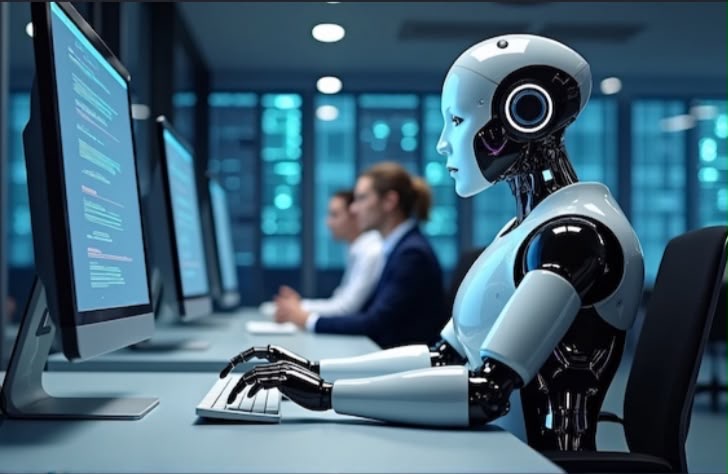
Across the world, similar scenes are becoming commonplace. Artificial Intelligence (AI) is rapidly transforming how businesses operate, how employees perform their duties, and the skills employers now demand. While the technology promises faster services, increased productivity, and new economic opportunities, it has also raised concerns about the future of employment.
As AI continues to reshape workplaces, an important question emerges: Is artificial intelligence creating new opportunities for workers, or is it becoming a threat to the future of jobs?
Unlike earlier technological innovations that mainly automated physical labour, AI has the ability to perform tasks traditionally associated with human intelligence. It can analyse complex data, generate written content, create images, translate languages, write computer code, and even assist doctors in diagnosing diseases. As organisations adopt these capabilities to improve efficiency and reduce costs, many occupations are being transformed.
The effects are already evident across several sectors. Financial institutions use AI to automate customer support and fraud detection. News organisations employ AI to assist with research, transcription, and content production.
Hospitals rely on AI to support medical diagnosis, while manufacturers use intelligent systems to improve quality control and streamline production. In classrooms, students increasingly depend on AI-powered tools for assignments, research, and personalised learning.
These developments have fuelled growing concerns among workers, particularly those whose jobs involve repetitive and predictable tasks. Administrative assistants, data entry clerks, customer service representatives, and bookkeeping personnel are among occupations considered more vulnerable to automation.
Yet many experts argue that the conversation should not focus solely on jobs that may disappear but also on the new opportunities that AI is creating.
According to the World Economic Forum’s Future of Jobs Report 2025, technological change—including artificial intelligence—is expected to create 170 million new jobs globally by 2030 while displacing about 92 million, resulting in a net gain of 78 million jobs. The report also estimates that 22 per cent of today’s jobs will undergo significant transformation, while nearly 40 per cent of workers’ core skills will change over the same period.
These findings suggest that AI is not simply eliminating jobs; it is changing the nature of work itself.
History provides similar examples. The widespread adoption of computers reduced demand for typists but created entirely new careers in information technology, software engineering, cybersecurity, and digital communications. Likewise, AI is giving rise to occupations such as machine learning engineers, AI ethics specialists, prompt engineers, data scientists, and AI policy advisers.
The challenge, therefore, may not be competing against AI but learning to work alongside it.
This view is reinforced by the International Labour Organization (ILO), which notes that while one in four jobs globally is exposed to generative AI, most occupations are more likely to experience transformation than complete replacement. Rather than replacing workers outright, AI is expected to automate specific tasks, allowing employees to focus on responsibilities that require creativity, judgement, communication, and emotional intelligence.
For young people preparing to enter the labour market, these uniquely human skills may become increasingly valuable. Employers are no longer looking only for academic qualifications but also for adaptability, critical thinking, leadership, collaboration, and the ability to use emerging technologies responsibly.
Universities also face a growing responsibility. Beyond introducing students to AI tools, higher institutions must teach AI literacy—helping learners understand how these technologies work, recognise their limitations, evaluate AI-generated information critically, and apply them ethically in professional environments.
For countries like Nigeria, where thousands of graduates enter the labour market each year, preparing young people for an AI-driven economy has become increasingly urgent. AI presents enormous opportunities for innovation, entrepreneurship, remote work, and digital business. However, without adequate investment in education and digital skills, many workers could struggle to remain competitive.
The International Monetary Fund (IMF) estimates that AI could affect around 40 per cent of jobs worldwide, with advanced economies experiencing even greater exposure. The organisation warns that while AI has the potential to increase productivity and economic growth, it could also widen inequality if governments fail to invest in skills development and policies that help workers adapt.
Fortunately, many organisations are already responding to these changes. According to the World Economic Forum, 77 per cent of employers plan to invest in reskilling and upskilling their workforce to prepare employees for AI-enabled workplaces. This reflects a growing recognition that human talent will remain indispensable, even as intelligent technologies become more capable.
Ultimately, artificial intelligence is neither the hero nor the villain of the modern workplace. Like previous technological revolutions, its impact will depend largely on how societies choose to adopt, regulate, and prepare for it.
For today’s students, graduates, professionals, and policymakers, the future of work is unlikely to be defined by competition between humans and machines. Instead, it will be shaped by those who can combine human creativity, ethical judgement, and emotional intelligence with the power of artificial intelligence.
In the years ahead, the question may no longer be whether AI will replace jobs, but whether workers are prepared to evolve with the technology. Those who embrace lifelong learning and continuously develop new skills are likely to discover that AI is not merely a threat—it is also one of the greatest opportunities of the twenty-first century.










Nigeria @66: Arewa Youths President Urges Nigerian Youths to Promote Unity

Nigeria @ 66: Zulum visits hospital, says most kidney failure linked to BP, Diabetes

Yankari Game Reserve: A Forest Where Wild Animals and Humans Relate

Dlakwa Assumes office as Acting Vice Chancellor, Borno State University ”BOSU”

Jonathan visits Tinubu at Aso Villa
