By Abubakar M. Kareto
In Nigerian political history, the office of the Vice President has frequently occupied an awkward constitutional perimeter.
Often relegated to an administrative reserve or constrained by executive caution and domestic routine, the position has rarely functioned as a primary instrument of foreign policy. Since the dawn of the Fourth Republic in 1999, the executive dynamic has oscillated between two predictable traps: redundancy or rivalry. Atiku Abubakar commanded domestic privatization before descending into open confrontation with Olusegun Obasanjo; Goodluck Jonathan managed domestic security pacification in the Niger Delta while foreign shuttles remained presidential; and Yemi Osinbajo led the National Economic Council and domestic tech initiatives while Muhammadu Buhari held foreign plenary representation tightly within his own itinerary.
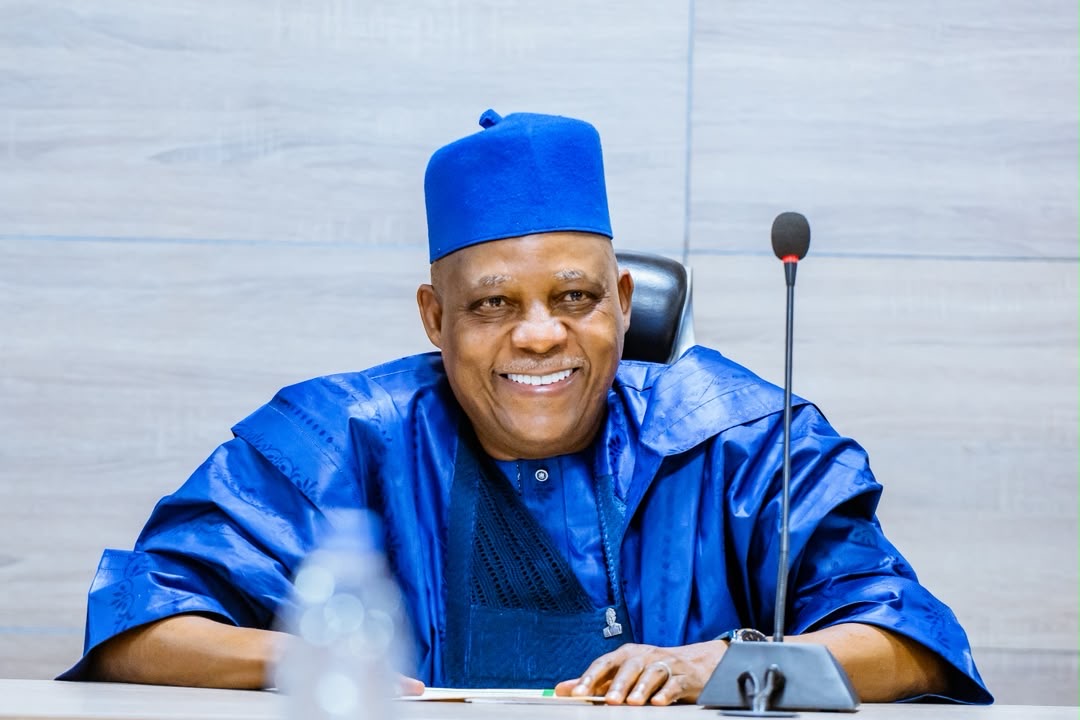
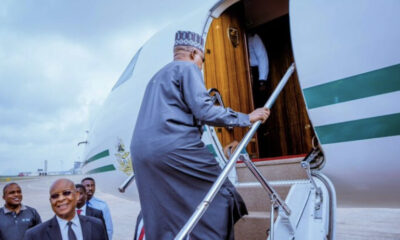
Under President Bola Ahmed Tinubu, however, the administration has broken this institutional inertia by pioneering a deliberate model of parallel statecraft. Rather than sidelining the Vice President out of traditional executive paranoia, the presidency has entrusted Vice President Kashim Shettima with an unprecedented, high-stakes external portfolio without relieving him of his constitutional domestic steering. The empirical proof of this model was demonstrated during his recent three-week diplomatic shuttle: moving seamlessly from the African Union Extraordinary Assembly in Luanda to the 18th BRICS Summit in New Delhi, and culminating at the 81st United Nations General Assembly in New York. Across three continents, Shettima proved that loyalty in modern governance can be deeply intelligent, highly articulate, and strategically assertive.
To grasp Shettima’s agility on the global stage, one must re-examine his tenure as Governor of Borno State from 2011 to 2019 through the lens of subnational paradiplomacy. Governing at the epicenter of the Boko Haram crisis compelled him into non-traditional external engagement. Managing cross-border security imperatives across the Lake Chad Basin alongside Chad, Niger, and Cameroon, while negotiating directly with the United Nations, the World Bank, and foreign donor agencies, broadened his executive horizon. While many of his gubernatorial peers focused strictly on internal party politics and federal revenue allocations, Shettima was forced to master multilateral negotiation, international development protocols, and global resource mobilization. That protracted baptism of fire became an executive laboratory, providing foundational experience for his current global assignments.
The three-capital shuttle revealed how this background has matured into a formidable diplomatic doctrine. In Luanda, during the 21st Extraordinary Session of the African Union, Shettima demonstrated that quiet diplomacy can carry an uncompromising edge. Breaking with decades of passive communiqués, Nigeria formally tabled the motion on recurring xenophobic and Afrophobic attacks in South Africa, moving the issue from transient public outrage into the institutional machinery of the African Union docket for 2027. Channeling Chinua Achebe to remind peers that those whose palm kernels were cracked by benevolent spirits must remain humble, he defended national dignity while warning against the dangerous reliance on foreign mercenaries and private military contractors fracturing the Sahel.
In New Delhi, at the 18th BRICS Summit, that defense of dignity shifted to an economic offensive. Positioning Nigeria not as an anti-Western agitator but as an architect of South-South agency, Shettima delivered a defining technological directive: developing nations can no longer afford to rent their future by exporting raw commodities and importing finished technologies. Demanding that the Global South create its own knowledge, patent its own inventions, and secure artificial intelligence sovereignty, he showcased Nigeria’s domestic initiatives, such as the 3MTT tech talent drive and Project BRIDGE broadband expansion, proving that domestic capacity building must backstop foreign investment pitches.
This strategic momentum reached its crescendo at the 81st UN General Assembly in New York. Delivering Nigeria’s national statement, Shettima took aim at the structural paralysis of the post-war multilateral order, declaring that the world of 2026 cannot remain held hostage to the power settlements of 1945. Grounding his intervention in the Ezulwini Consensus and the Sirte Declaration, he explicitly demanded at least two permanent African seats on the UN Security Council with full veto prerogatives alongside five non-permanent positions. In doing so, he dismantled patronizing international proposals offering Africa second-class, ceremonial permanence without voting equality.
Crucially, this demand for multilateral restructuring was not advanced as an ideological entitlement, but as an earned sovereign reality. Shettima substantiated Nigeria’s claim by recounting decades of national sacrifice across the continent, reminding the world of Abuja’s blood, treasure, and mediation across Liberia, Sierra Leone, Darfur, Mali, and The Gambia. This record of operational sacrifice challenges the orthodox assumption that Security Council stewardship belongs strictly to accumulated financial reserves or nuclear arsenals, establishing that regional peace-building is the true foundation of global stability.
Beyond the main plenary, Shettima translated this diplomatic assertiveness into practical economic statecraft. At the Africa Minerals Strategy Group roundtable, he moved the continent from passive grievance to cartel-like coordination, asserting that Africa must halt raw mineral flight and mandate local processing, lithium refining, and battery manufacturing. Engaging the Nigerian diaspora, he reframed migration from a brain drain into economic leverage, citing rising foreign reserves and macroeconomic stabilization. Furthermore, in co-hosting the Global Partnership for Education drive alongside Italian Prime Minister Giorgia Meloni, he demonstrated fiscal innovation by revealing how Nigeria is mobilizing domestic recovered assets and dormant funds to finance national student loans and teacher capacity.
Critics who question the necessity of sustained foreign missions amid domestic economic readjustment misread the architecture of modern economic governance. In an interconnected 21st-century economy, domestic inflation, currency stabilization, and food security are inextricably tied to foreign capital inflows, balance-of-payments support, and multilateral debt relief. Domestic reform cannot succeed in international isolation. Shettima’s external deployments serve as the outward anchor of Nigeria’s internal restructuring.
Ultimately, this dual-track governance model proves that a nation speaks most effectively when its leadership demonstrates total policy coherence. By entrusting Vice President Kashim Shettima with high-stakes statecraft across the capitals of the world while anchoring statutory economic coordination at home, President Tinubu has instituted an agile, modern executive partnership. From Luanda to New Delhi, and onto the world stage in New York, Shettima has proved that when intellect, diplomatic courage, and executive fidelity converge, Nigeria does not merely attend global summits; it actively shapes the terms of global engagement.
Author Bio
Abubakar M. Kareto is a Public Affairs Analyst and Communications Strategist focusing on governance, policies, economy, and institutional reforms across Nigeria and Africa. He can be reached on X @amkareto and via email at amkareto@gmail.com.